Hover (or tap) a block to see what happens in that slot.
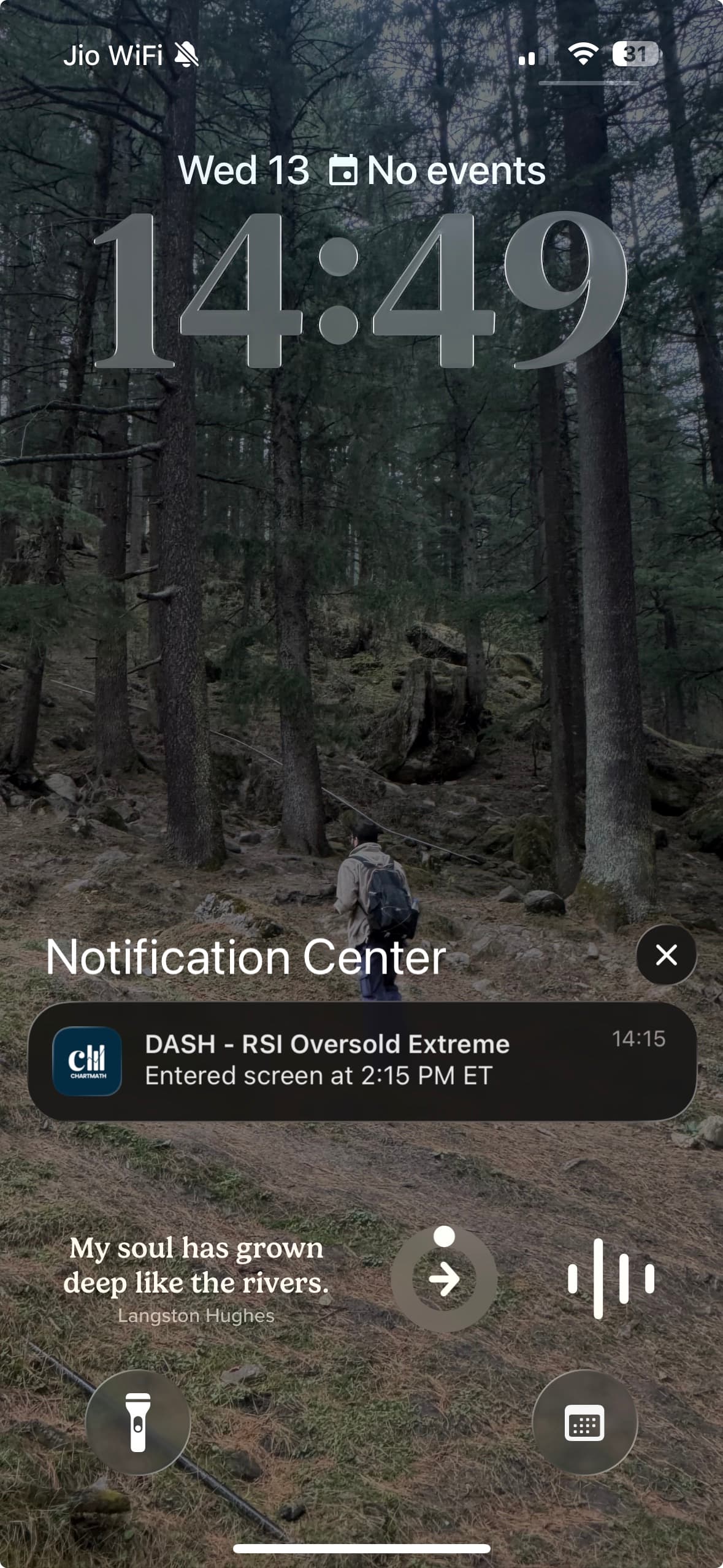
Tuesday, 2:15pm. You're at your day job, in a status meeting. Your phone flashes: a ChartMath push that one of your subscribed screens just admitted AAPL. The card carries a win rate, an R-expectation, a sample size, and a price level you'd enter at. You have a sixty-second decision. Does this pass the criteria you'd use Sunday night? If yes, you size it and arm the bracket at your broker. If no, you swipe past and go back to the meeting. The day job is the discipline.
Essay 1 told you why five trades aren't feedback. Essay 2 told you what a real trade looks like: entry, stop, R-expectation, sample size. This essay is the rhythm that lets those four numbers actually compound, written for the reader most retail trading content forgets exists, the person trying to do this with a day job.
Mark Rippetoe wrote a book called Starting Strength that teaches a brutally simple weight-training program: a handful of barbell lifts, three sessions a week, add five pounds every session until you can't anymore.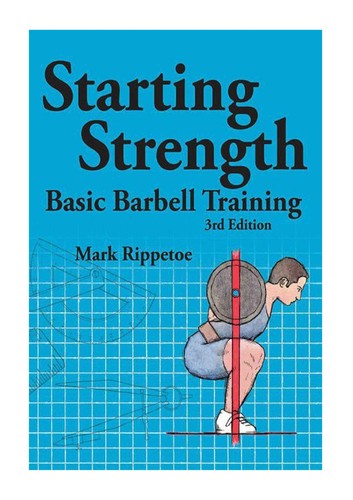 Starting Strength1. The line the whole lifting community jokes about: “the program works because you run the program.” The temptation for beginners is always to add a sixth lift, swap a barbell for a machine, or skip the warm-up sets, and every variation from the program makes it work less well. Same shape as retail trading. The program is so simple that lifters spend their first year trying to improve it. They add lifts. They swap exercises. They skip days. The ones who get the strongest are the ones who just ran the program, exactly as written, for a year.
A systematic retail trading week is the same shape. The hard part isn't knowing what to do. The hard part is running the program without adding anything to it. The rest of this essay is the program, the failure modes a busy person will feel pulled toward at 2pm on a Wednesday, and the discipline checks that grade you on what brackets can't enforce.
The trading work moved.
You're still the trader. What changed is when the trading happens. The four numbers from Essay 2 still get decided by you. They just get decided once, the evening before, instead of in real time while a chart is moving.
At 10pm you subscribe to the screens you want pinged, then sweep Discover. A screener is a checkable rule that scans every name in your universe and flags the ones that pass. The ChartMath screens page is a catalog of these rules; pick the ones worth being pinged on. The bracket orders you then arm at the broker hold your four numbers together overnight: the broker fires the entry when price hits, and enforces the stop and target without you. The 11am version of you doesn't get a vote on the pre-armed trade, because the 10pm version of you already had it.
What ChartMath does. What your broker does.
ChartMath is a research surface. The Discover feed ranks (stock, screen, best-strategy) cards for you to sweep. The Screens catalog holds the rules you can subscribe to. Alerts fire when a subscribed screen admits a new name, or when a price alert on a held stock trips. Strategy Analytics is where you re-read the four numbers behind any card.
Your broker is the execution surface. Orders, brackets, fills, positions, P&L all live there. ChartMath surfaces the trades worth placing and the trades worth re-reading; your broker holds and executes them.
Your day job is an edge.
A full-time retail trader sits at the screen for six hours and tries not to interfere. Anyone who has tried this knows how the day ends. The market dares you for six hours. Most days you lose to it. You tighten a stop on a trade you should have left alone. You take a smaller position on the next setup because the last one bled. You open a small “just to feel involved” trade off-system at 1pm.
A swing trader with a day job structurally cannot intervene during those six hours. You're in meetings. You're writing code. You're seeing patients. You're teaching a class. The market opens, the brackets fill, the system runs. You're not at the screen to second-guess any of it. The thing that feels like a limitation, not being able to watch all day, is the thing protecting your R-expectation from your worst self.
This is the inversion most retail traders never make. Full-time at the screen looks like the dream. It is, mathematically, the harder mode. A job that takes your attention for six market hours is structural alpha you didn't have to pay for. The systematic week is built around making sure you don't throw it away.
The week, move by move.
The whole week is five discrete touchpoints. Total time: under two hours. The rest is the market doing what you set it up to do, while you do the work that pays for the brokerage account.
Plan the trades (10 min): night-before or pre-market.
Your real planning work fits in ten minutes, and there are two windows you can do it in. Night-before lets you sleep on the decisions. Pre-market lets you read overnight and extended-hours moves before you arm. Pick one. ChartMath alerts don't fire in extended hours, so there's no catch-up work either way. The flow below is identical in both windows.
You open ChartMath and sweep Discover, a vertically swipeable feed of (stock, screen, best-strategy) cards. Each card carries a chart, a win rate, an expected value per trade, entry / stop / target, and the screen that fired. Star the cards worth a bracket to your Watchlist.
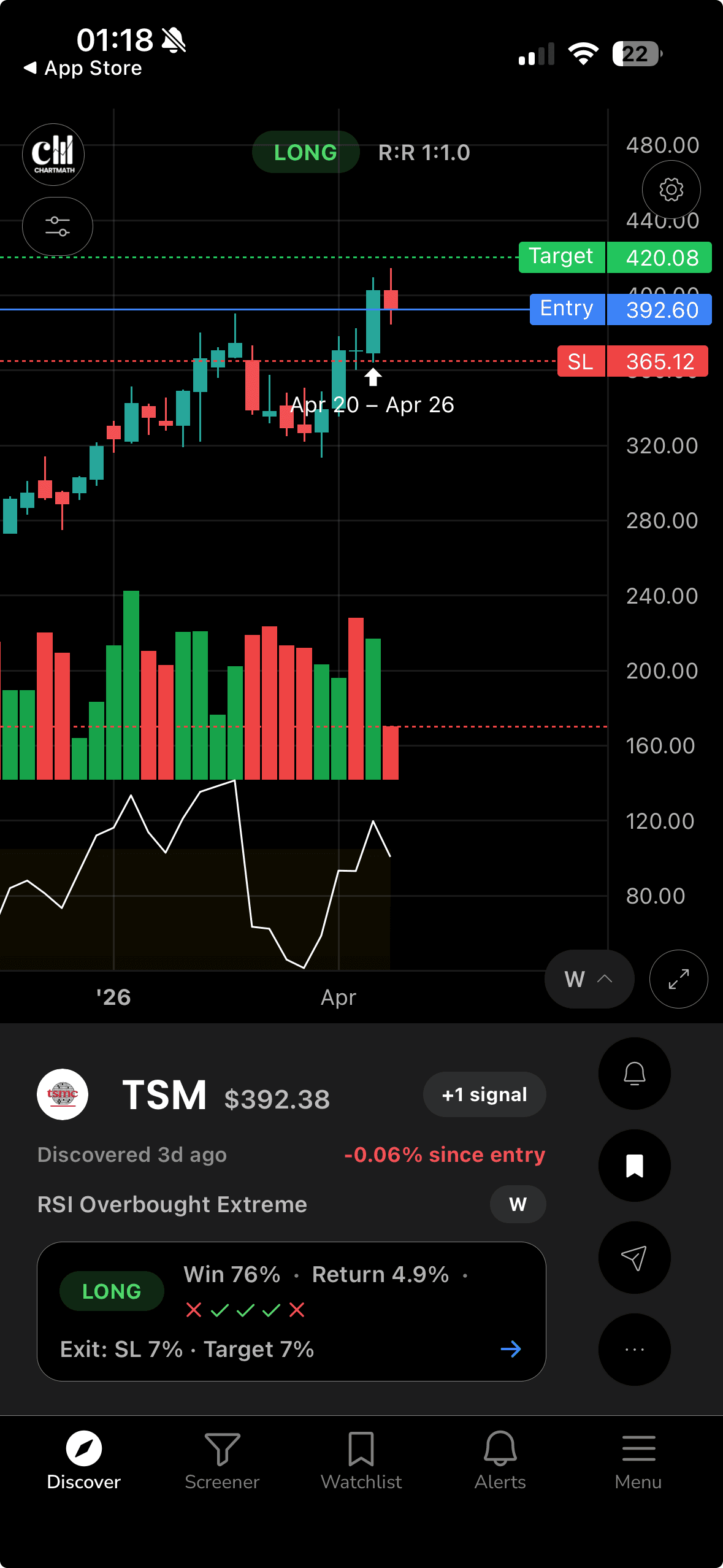
Then you switch to your broker. For each starred card you size the position, then arm a bracket order. Nothing about the trade is left to be decided in the morning, when you'll be rushed and away from the chart.
Most retail traders place open-ended orders: buy at market, decide the exit later. A bracket packages entry, stop, and target as one OCO group. Your broker holds all three until the entry triggers, then enforces stop and target without you.
Set the fires you want pinged. ChartMath has two alert mechanisms, and you turn them on here. Screen subscription fires a push when a starred screen admits a new name; you pick Watchlist-only or All Instruments. Price alert fires when a specific stock crosses a level on Price, SMA, EMA, RSI, VWAP, Volume, or ATR, with operands greater-than, less-than, or crosses. The AAPL push at 2:15pm tomorrow is one of these two.
Work hours: silent unless a push fires.
Most of the day, ChartMath is silent. Your pre-armed brackets fill at your broker, and the stops and targets manage themselves. You are not at the screen for any of it.
When a screen-subscription push or a price alert does fire, you have a sixty-second decision. The bar is the one you'd apply Sunday night: the four numbers from Essay 2 (entry, stop, R-expectation, sample size), plus a size you can honor. If the card clears that bar, you size it and arm the bracket at your broker. If it doesn't, you swipe past and go back to work. Same bar as Sunday night, just in real time. Passive isn't frozen. The discipline is in the sixty-second check, not in refusing to look.
Lunch touchpoint (10 min).
Lunch is your one scheduled mid-day check-in. Three passes, in order. First, a broker pass: confirm fills, glance at positions. Second, a ChartMath pass: Alerts >Triggered for the morning's fires, Watchlist for held names. Third, a 5-minute Discover sweep, where you star anything worth a bracket to the Watchlist.
A card from the Discover sweep can become a bracket at lunch. If it passes the same sixty-second check you'd run on a work-hours push, you size it and arm it at your broker. What doesn't happen at lunch is tinkering with positions you already hold, or scrolling for the sake of scrolling. Don't open either app unprompted. A fired push is fair game; idle scrolling between touchpoints is the trap. The market being in front of you is what makes you tinker; not having it in front of you is the edge a day job hands you for free.
Four scenes a day-job trader actually faces. Pick what you'd do before you reveal.
What's the systematic move?
Four scenes a day-job trader actually faces. Pick before you reveal. Sometimes the systematic move is to act; sometimes it's to let the bracket run. Both are part of the program.
- 1Wednesday, 12:40pm.
Your lunch Discover sweep surfaces a fresh card on a name you already hold with a bracket. The card's expected value reads higher than the bracket you armed last night.
What's the systematic move?
- 2Tuesday, 2:15pm.
Your phone buzzes during a status meeting. A screen-subscription push fires on a name you don't hold. The Discover card shows a clean setup.
What's the systematic move?
- 3Friday, 3:50pm.
Ten minutes to close. One position is up +0.8R, not yet at its target. The chart looks like it might roll over. Your gut says 'lock it in.'
What's the systematic move?
- 4Sunday night, 9pm.
You're scrolling Twitter. A retail trader posts a +14R week on a setup you don't run, with screenshots. Your subscribed screens fired four trades this week and netted +0.4R.
What's the systematic move?
Notice the pattern. Each wrong move is reasonable in the moment. Doubling on a held name is “conviction.” Re-pricing mid-flight is “adapting.” Tightening at 3:50pm is “locking in.” A tapped market order is “before the move runs.” Refusing to look is “discipline.” None of them is the sixty-second criteria check.
Close (5 minutes): did I leave it alone?
After the close, three checkboxes. Not P&L. The brackets already enforced your stop, size, and exit, so grading those is grading what they enforced. What they can't enforce is your behavior between touchpoints. That's what you grade:
- Did I leave open positions alone today? No stops moved, no early exits, no adds to a winner.
- Did I avoid opening anything off-system? No phone-tap entries, no “small test” positions, no chasing what wasn't pre-armed.
- Did I keep my stops where I placed them last night? No tightening to lock in. No widening to give it room.
Three yes-or-no answers. If today was 3-for-3, you stayed out of the program's way. That's the score. The P&L for today is a result, not a score. The casino tracks discipline. The table tracks money.
The drawdown moment.
Every systematic program will go through a drawdown that asks you to break it. This is mathematically certain. Even a 60% win-rate system will run into a streak of six losses in a row several times a year, and a 42% win-rate system will see nine-in-a-row stretches regularly.The math of losing streaks2. The probability of six losses in a row at a 40% loss rate is 0.46, about 0.41% per trade. Sounds tiny until you stack a year of trades: at one trade a day, that's ~250 trials, and at 0.41% per trial you get a 6-in-a-row streak more than once a year in expectation. At a 58% loss rate (a 42% win-rate system), nine-in-a-row is 0.589, about 0.8% per trade, which over 250 trades is two streaks a year on average. The system isn't broken when it streaks; it's doing what its distribution said it would.
When the streak happens, you will be looking at the equity curve at its lowest point, and you will believe, sincerely, with conviction, with what feels like fresh perspective, that the system is broken. That is the moment the system asks you whether you're the house or the gambler.
62% win rate, 1.8R avg. Looks elite, until trade #142.
Every system has a moment where it asks you to break it. The curve below is simulated from the strategy's real win rate and R numbers, and we picked a deliberately ugly stretch, the kind this math will produce sooner or later. Pick your move, lock it in, then see what discipline costs and what discretion costs.
Almost every retail failure mode in trading is some version of intervening in the program at the worst possible moment. Skipping the next trigger because you've had a streak. Tightening the entry filter to be “more selective.” Cutting the size in half. Quitting and rotating to a different system. Each of these breaks the program right at the point where it was about to do what it was supposed to do, which is to mean-revert from a losing streak that was always part of the distribution.
The system asks you to break it at the exact moment running it has the highest expected value.
Weekend review: where the trading work actually happens.
The whole week, all five days, was execution. Sunday is the only block where you make decisions about the program itself. Total time: thirty minutes.
Part A: roll up the fire log.
Alerts > Triggered is the week's fire log. Every row is a fire that admitted a name to a screen. Each row deep-links to Strategy Analytics, where you re-read the four numbers as they stood that night. Cross-check against your broker's trade log to see which fires you took, and which you let pass.
You roll up the discipline score out of fifteen (three checks across five days). Where did you skip a check, and why? You grade every trade on process, not P&L. Where did you size up because something “felt good”? Where did you sit out a trigger because of a hunch? You write the patterns down.
Part B: what worked. What didn't.
Three prompts. Sit with each one with your journal open.
- Which Triggered fires did I act on? Which did I let pass, and why? Open Alerts > Triggered, walk the rows, annotate the skips.
- Which subscribed screens earned their slot this week? Which didn't? Open the Screens catalog, look at the firing names and their follow-through.
- One rule change for next week, or zero changes. Zero changes is a valid answer. The bar for editing the system is high.
This is the only loop where the system gets edited. Tuesday at 2pm is execution; Sunday at 6pm is design. Not on Tuesday at 2pm. Not after a losing Wednesday. Sunday, in thirty minutes, while you have perspective. Process is the leading indicator. P&L is the lagging one. You can predict next quarter's P&L from this quarter's discipline score. You can't predict next quarter's discipline from last quarter's P&L.
This is the part busy people miss. Thirty minutes on Sunday is your entire trading week's worth of decisions. The rest is execution that runs while you live your life.
Where each touchpoint lives.
One glance, before the unglamorous answer. Five touchpoints across the week, mapped to which app you open and what you do there.
| Touchpoint | ChartMath | Broker |
|---|---|---|
| Night before OR pre-market (10 min) | Sweep Discover; star Watchlist; set alerts. | Arm bracket orders on starred names. |
| Work hours | 60-second check on any push; arm if it passes. | Brackets fill, stops and targets manage themselves. |
| Lunch (10 min) | Triggered + Watchlist + 5-min Discover sweep. | Confirm fills; arm a fresh bracket if a card passes. |
| Close (5 min) | Three discipline checks. | (silent) |
| Weekend review (30 min) | Alerts > Triggered into Strategy Analytics; 3-prompt reflection. | Cross-check trade log. |
The unglamorous answer.
The systematic retail week is, frankly, boring. Ten minutes the night before, or pre-market, pick one. Brackets that fill at your broker while you work. A sixty-second check on any push that fires. A ten-minute lunch touchpoint. A five-minute discipline check at the close. A thirty-minute weekend review. You will spend almost none of your week actually trading. You will pass on plenty of charts that look obvious. You will hold positions through what your gut tells you are turning points. You will get beaten, for a week or a quarter, by tipsters whose calls win three times in a row before their fourth blows the account.
And the equity curve will, in expectation, go up and to the right, because the math you set up in Essay 2 is the math that's running. The trader is you. The trading just got moved to a ten-minute slot at 10pm and a thirty-minute slot on Sunday. The rest is the program working in the background, while your day job protects you from yourself.
Did you stay out of the program's way this week?
Three checks a day: left it alone, no off-system opens, stops untouched. Brackets handled the rest.
Brackets handle the mechanics. Discipline handles you.
Three essays, one idea. Essay 1 was the frame: sample size, the casino floor, grading decisions instead of outcomes. Essay 2 was the system: entry, stop, R-expectation, and the sample size that makes the expectancy real. This essay was the rhythm that lets the system compound over a real human week: the touchpoints, the day-job edge, the discipline the brackets can't enforce.
That's the series. Three actions to install the loop: subscribe to one screen, open Discover and pick one card, arm that card's four numbers at your broker. Then go to work.