Real-Time vs End-of-Day Scanner Software: Which Delivers Better Trading Results in 2026?
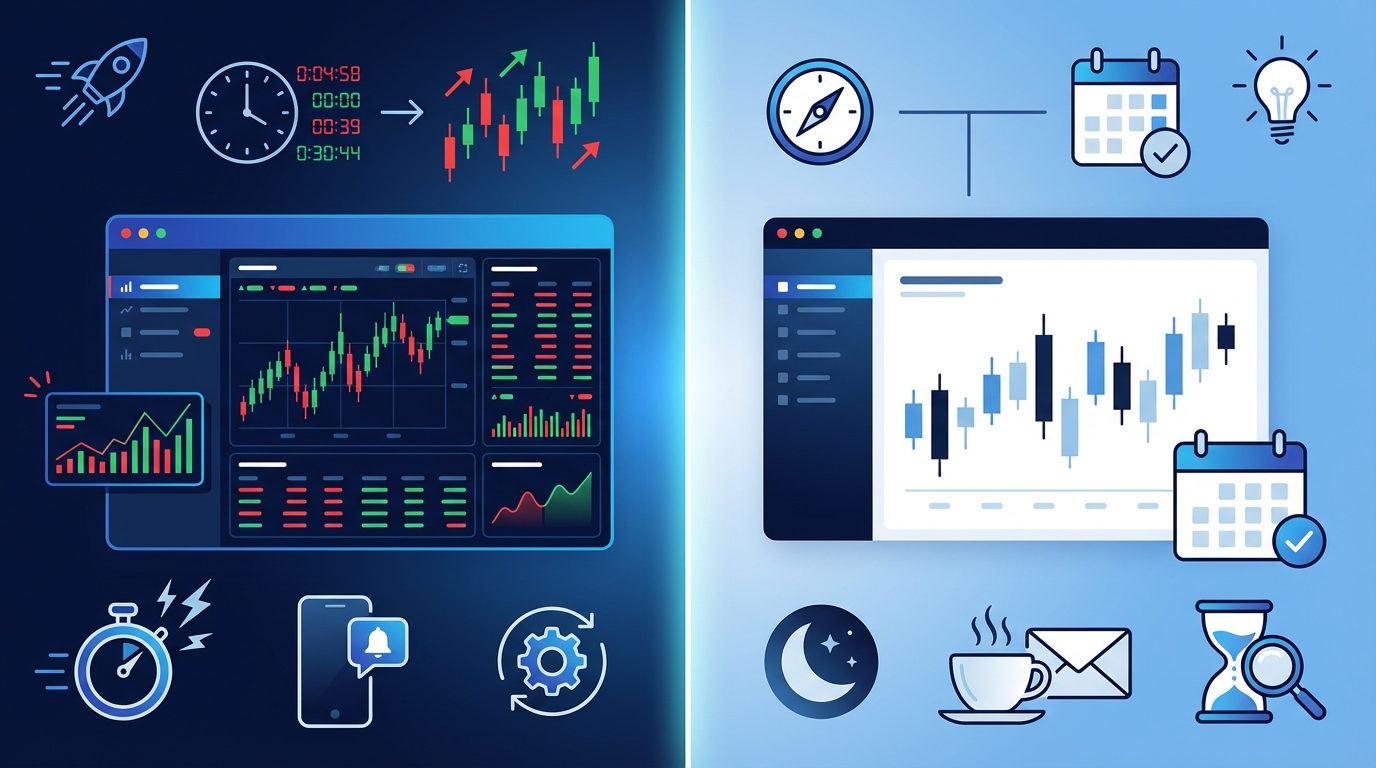
Table of Contents
You've refreshed your stock screener for the 47th time today. Still nothing. Meanwhile, that momentum play you spotted this morning already ran 15% before you could even set up the trade. Sound familiar?
The difference between catching a winning trade and watching it slip away often comes down to one critical decision: choosing between real-time and end-of-day scanner software. For technical traders in 2026, this choice directly impacts your trading results, your daily workflow, and ultimately, your profitability.
This comprehensive comparison breaks down the key differences between real-time and end-of-day scanners, examining performance metrics, pricing models, and use cases for both day traders and swing traders. More importantly, we'll explore how a backtested stock screener can validate your setups regardless of which scanner type you choose. By the end, you'll know exactly which approach fits your trading style and delivers better results.
Understanding Scanner Software: Real-Time vs End-of-Day
Before diving into the comparison, let's establish what we're actually comparing. Scanner software analyzes thousands of stocks against specific technical criteria and alerts you when opportunities match your trading setups. The fundamental difference lies in when and how often this analysis happens.
Real-time scanner software continuously monitors the market throughout the trading session, processing live price data, volume changes, and technical indicator movements as they happen. When a stock matches your criteria (like an opening range breakout, VWAP reclaim, or relative volume spike), you receive an immediate alert. These scanners update every few seconds or even milliseconds, depending on the platform and data feed quality.
End-of-day scanner software operates on a different schedule entirely. These tools process market data after the closing bell, typically running their analysis overnight. You receive results the next morning, showing which stocks met your criteria based on yesterday's completed price action. This approach works with static, historical data rather than live market conditions.
The technical differences extend beyond timing. Real-time scanners require robust server infrastructure, premium data feeds from exchanges, and sophisticated alert delivery systems to handle thousands of simultaneous calculations. End-of-day scanners process data in batches during off-hours, requiring less computational power and simpler data feeds.
Why does this choice matter for your trading outcomes? Because your trading strategy dictates your data needs. A day trader executing 1-minute scalps needs to know about an ORB break the moment it happens. A swing trader building a watchlist for next week's positions can work perfectly well with yesterday's closing data. The mismatch between scanner type and trading style is where traders lose money, miss opportunities, and experience unnecessary frustration.
Performance Metrics: Speed, Accuracy, and Reliability
When evaluating scanner software, three performance metrics matter most: speed, accuracy, and reliability. Let's examine how real-time and end-of-day scanners stack up across each dimension.
Speed represents the most obvious difference. Real-time scanners deliver alerts within seconds of a technical setup forming. When a stock breaks above its opening range at 9:35 AM, you know about it at 9:35 AM, not tomorrow morning. This millisecond-level responsiveness enables you to enter trades near the beginning of a move rather than after the opportunity has passed.
End-of-day scanners operate on a 24-hour delay by design. The "speed" metric here measures how quickly you receive results after market close. Most platforms deliver scans within 30 minutes to 2 hours after the 4:00 PM bell. For swing traders, this timing works fine since you're planning tomorrow's or next week's trades, not trying to catch an intraday momentum surge.
Accuracy involves correctly identifying setups that match your criteria. Both scanner types can achieve high accuracy, but they measure different things. Real-time scanners must process streaming data and make split-second decisions about whether a setup has truly formed or if it's just noise. False positives happen when a stock briefly touches a technical level but doesn't sustain the move.
End-of-day scanners benefit from analyzing completed price action. There's no ambiguity about whether a stock closed above resistance or finished the day with elevated volume. The data is final. However, this "accuracy" comes at the cost of timeliness. You're accurately identifying yesterday's opportunities, which may or may not be relevant tomorrow.
Reliability encompasses uptime, data feed quality, and alert consistency. Real-time scanners face higher reliability challenges because they depend on continuous data streams from exchanges, robust server infrastructure to handle peak market hours, and reliable push notification systems. When any component fails during a volatile market open, you miss alerts.
End-of-day scanners have fewer moving parts. They process data during off-peak hours when server loads are lighter and data feeds are stable. The trade-off? If the overnight processing fails, you don't discover the problem until market open when you're expecting your morning scan results.
For traders using a backtested stock screener, reliability extends to the consistency of the backtesting methodology itself. Whether you're using real-time or end-of-day data, you need confidence that the historical performance metrics (win rate, average return, drawdown) were calculated using the same criteria your scanner applies today. Inconsistent backtesting makes performance data meaningless.
Pricing Models: What You Pay for Speed
The cost difference between real-time and end-of-day scanners can be substantial, and understanding the pricing structure helps you evaluate whether faster data justifies the investment.
Real-time scanner pricing typically ranges from $30 to $200+ per month, depending on features, data quality, and the number of simultaneous scans you can run. Premium platforms targeting professional day traders can exceed $500 monthly. These higher costs reflect the infrastructure required to deliver live market data and instant alerts.
Many real-time platforms offer tiered pricing. A basic tier might include delayed data (15-minute lag) or limited scans per day. Mid-tier subscriptions provide real-time data for major exchanges with a reasonable alert quota. Premium tiers add features like custom scan creation, API access, and priority alert delivery during high-volume periods.
End-of-day scanner pricing is considerably more affordable, with many platforms offering free basic versions or subscriptions in the $10 to $50 monthly range. Some established platforms like Finviz provide robust end-of-day screening at no cost, monetizing through premium features or advertising instead.
The lower cost structure makes sense: end-of-day data is cheaper to license from exchanges, processing happens during off-peak hours when server costs are lower, and the technical infrastructure is simpler. For traders who don't need intraday alerts, paying premium prices for real-time data wastes money.
Hidden costs deserve attention regardless of scanner type. Exchange fees can add $10 to $50+ monthly for access to real-time data from NYSE, NASDAQ, and other markets. Some platforms charge separately for premium features like backtesting tools, custom watchlists, or mobile app access. API access for integrating scanner alerts with your charting platform often requires top-tier subscriptions.
The ROI consideration is straightforward: does faster data help you make more profitable trades? If you're a day trader and real-time alerts help you catch three additional momentum plays per month, each averaging a $200 profit, that's $600 in additional gains. A $100 monthly scanner subscription pays for itself six times over. But if you're a swing trader taking two positions per week based on daily timeframes, paying $200 monthly for real-time data you don't use erodes your profitability.
Smart traders match their scanner investment to their trading frequency and strategy timeframes. The most expensive tool isn't always the best tool; it's the one that aligns with how you actually trade.
Day Traders: Why Real-Time Scanners Are Essential
For active day traders, real-time scanner software isn't a luxury—it's a fundamental requirement for executing your strategy effectively. The intraday trading environment moves too quickly for delayed data to be useful.
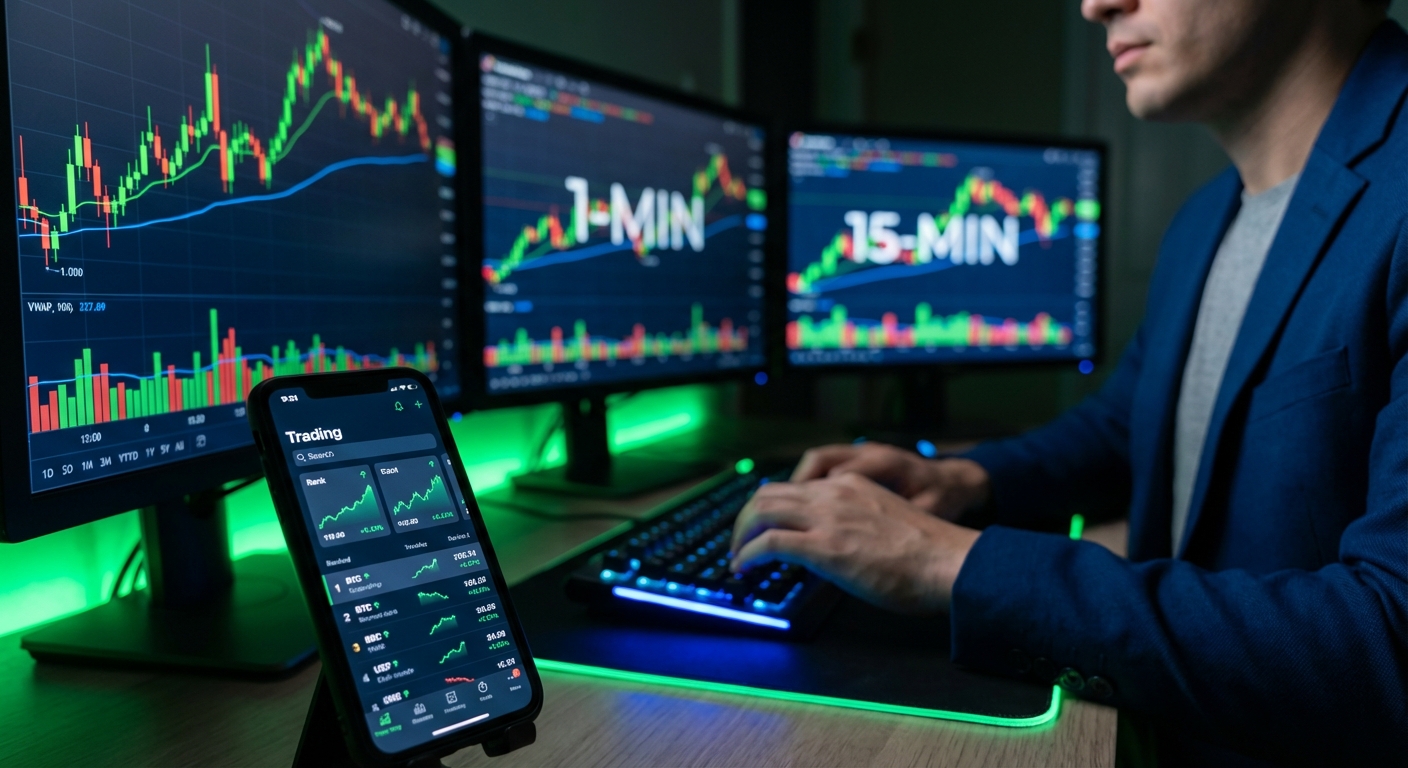
Consider the typical day trading workflow. You're monitoring opening range breakouts (ORB) in the first 15 minutes of the session. A stock consolidates in a tight range from 9:30 to 9:42 AM, then breaks above the high with a surge in volume. By 9:43 AM, the stock has already moved 3%. By 9:50 AM, it's up 8%. An end-of-day scanner will tell you about this opportunity tomorrow morning, when it's completely irrelevant. A real-time scanner alerts you at 9:42 AM when the breakout occurs, giving you a chance to enter near the beginning of the move.
The same principle applies to VWAP reclaims, one of the most reliable intraday setups. When a stock that's been trading below VWAP all morning suddenly reclaims it with strong volume, that's often the signal for a momentum continuation. These setups develop and resolve within 15 to 45 minutes. You need to know about them while they're happening, not after the market closes.
Relative volume (RVOL) spikes present another time-sensitive opportunity. When a stock suddenly trades 5x or 10x its average volume, something is happening—news, unusual options activity, or institutional accumulation. Day traders who catch these spikes early can ride the momentum. By the time an end-of-day scanner identifies the volume anomaly, the move is over.
Real-time scanners enable multi-timeframe monitoring that's critical for intraday trading. You might scan for 1-minute chart patterns for scalping opportunities, 5-minute setups for momentum plays, and 15-minute patterns for slightly longer holds. Managing this across dozens or hundreds of stocks manually is impossible. A real-time scanner does it automatically, alerting you only when high-probability setups form on your preferred timeframes.
The challenge day traders face is alert fatigue. When your scanner sends 200 alerts per day, you start ignoring them or missing the truly high-quality setups buried in the noise. This is where a backtested stock screener becomes invaluable. Platforms like ChartMath rank alerts by quality and freshness, showing you which setups have the highest historical win rates and expected value. Instead of 200 random alerts, you see the top 20 setups backed by actual performance data.
Real-world use cases demonstrate the value. A momentum trader using real-time alerts for RVOL spikes above 3x combined with price above VWAP might catch 5 to 10 quality setups per week. A breakout trader monitoring real-time alerts for ascending triangle breaks or bull flag continuations can identify 3 to 7 opportunities daily during volatile market conditions. A scalper watching for 1-minute ORB breaks on high-volume stocks might execute 15 to 25 trades per session.
None of these strategies work with end-of-day data. For day traders, real-time scanning isn't about convenience—it's about whether your strategy is even executable. Learn more about optimizing your intraday approach in our guide on how to use stock screeners for day trading in 2026.
Swing Traders: When End-of-Day Scanners Work Best
While day traders need real-time data, swing traders often find that end-of-day scanners provide everything they need at a fraction of the cost. The key difference is timeframe: swing trading strategies operate on daily and weekly charts, where intraday price fluctuations are just noise.
A typical swing trader holds positions for 3 to 10 days, sometimes longer. You're looking for multi-day breakouts from consolidation patterns, momentum continuation setups on the daily chart, or reversal patterns at key support and resistance levels. These setups develop over days or weeks, not minutes or hours.
Consider a stock forming an ascending triangle pattern over three weeks. The breakout above resistance might happen on any given day, but the setup itself is visible on the daily chart for weeks in advance. An end-of-day scanner can identify this pattern every evening, adding the stock to your watchlist. You don't need to know the exact minute the breakout occurs; you just need to know it's on your radar so you can place a buy stop order or check the chart during your morning routine.
The time efficiency advantage is significant for swing traders, especially those with full-time jobs or other commitments. You can run your end-of-day scans after market close, review the results for 20 to 30 minutes, update your watchlist, and set alerts for the next day. This evening routine replaces the constant monitoring required for day trading. You're not glued to your screen during market hours; you're making informed decisions based on completed daily price action.
End-of-day scanners also align with the lower trading frequency of swing trading. If you're taking 2 to 4 new positions per week, you don't need 50 real-time alerts per day. You need a curated list of 10 to 20 high-quality setups to review each evening. The slower pace means you can be more selective, focusing on the best risk-reward opportunities rather than chasing every intraday move.
The cost advantage matters too. Swing traders typically have smaller position sizes and lower trading frequency than day traders, which means lower overall trading volume. Paying $150 monthly for real-time data when you're only taking 8 to 12 trades per month doesn't make financial sense. An end-of-day scanner at $20 to $50 monthly (or free) preserves more of your trading capital for actual positions.
That said, swing traders still benefit enormously from backtested strategies. Knowing that a daily chart bull flag continuation has a 62% win rate with an average return of 8.4% over 5 days helps you size positions appropriately and set realistic profit targets. A backtested stock screener that shows historical performance for swing setups gives you the confidence to hold through normal pullbacks rather than exiting prematurely.
Platforms like ChartMath provide backtested data for both intraday and swing timeframes, so you can see which daily and weekly setups have actually worked historically. This data-driven approach removes the guesswork from swing trading. For more on building an effective swing trading routine, check out our 30-minute daily guide for busy professionals.
The bottom line for swing traders: end-of-day scanners provide all the data you need, when you need it, without the cost and complexity of real-time infrastructure. Save your capital for trades, not for data you won't use.
Backtested Stock Screener Features: What to Look For
Whether you choose real-time or end-of-day scanning, one feature separates effective tools from noise generators: backtested performance data. A backtested stock screener shows you the historical win rate, average return, and drawdown for every technical setup it identifies. This transparency transforms scanning from guesswork into evidence-based trading.
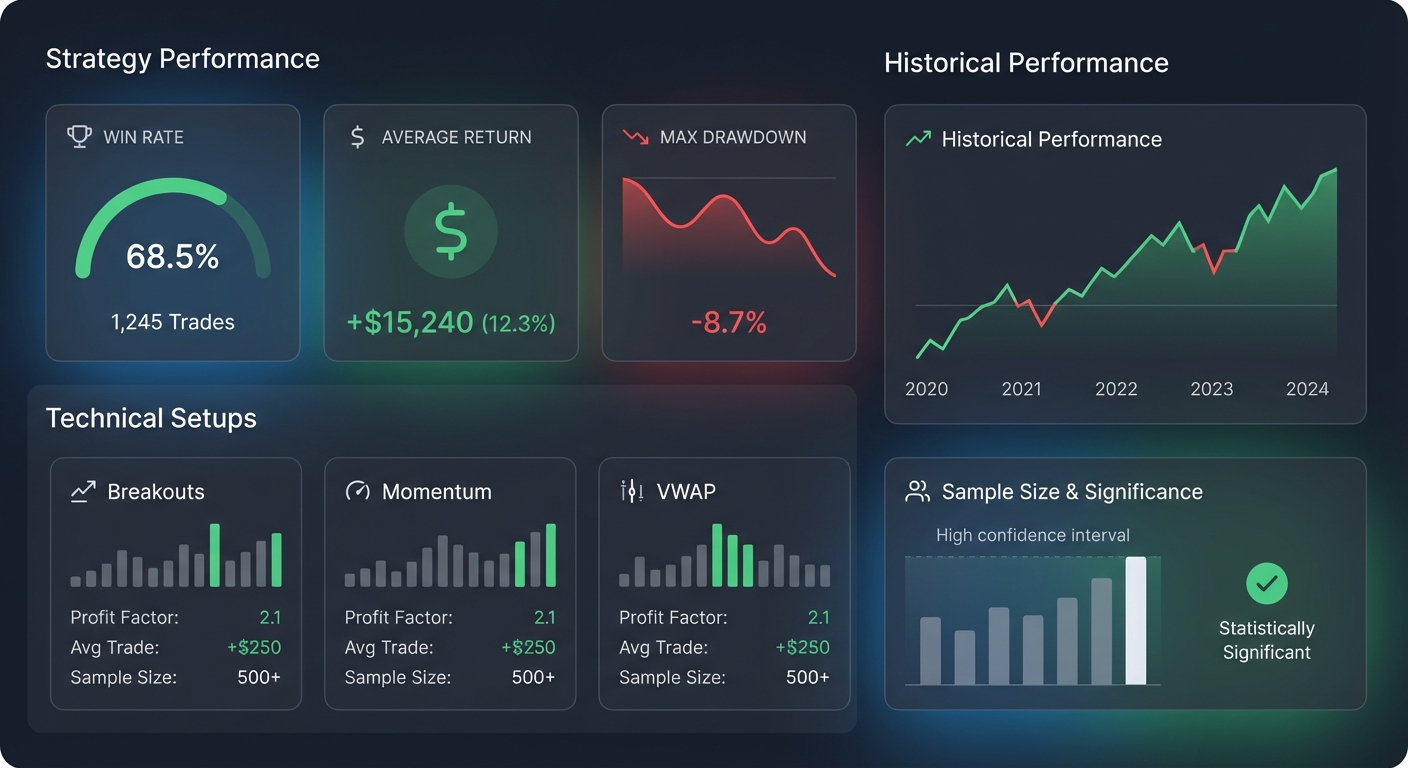
Here's what to look for in a quality backtested stock screener, regardless of whether it operates in real-time or end-of-day:
Historical performance metrics should include at minimum: win rate (percentage of trades that were profitable), average return per trade, maximum drawdown (largest peak-to-trough decline), and sample size (number of historical occurrences). Without these metrics, you're trading blind. A setup that "looks good" on a chart might have a 35% win rate historically, meaning you'll lose money over time even if individual winners feel great.
The sample size matters enormously for statistical significance. A setup with a 75% win rate based on 8 historical occurrences tells you almost nothing. That same 75% win rate based on 500 occurrences gives you real confidence. Look for scanners that show sample sizes and ideally filter out setups with insufficient historical data.
Transparency in methodology separates legitimate backtesting from marketing hype. The best platforms show you the actual filters and criteria used to identify setups, the exact entry and exit rules tested, and the time period covered by the backtest. Black-box AI systems that assign "confidence scores" without explaining the underlying logic are impossible to validate or trust.
For example, ChartMath provides transparent backtesting across 200+ technical screens, showing the specific filters (price above VWAP, RVOL above 2.5x, volume spike in last 5 minutes, etc.) and the historical results when those exact conditions occurred. You can see why a setup triggered and what happened historically when similar setups formed. This transparency lets you make informed decisions rather than blindly following AI recommendations.
Multiple exit strategies in backtesting provide crucial context. A breakout setup might show a 58% win rate with a 1:1 risk-reward exit, but a 67% win rate with a trailing stop that lets winners run. Seeing performance across different exit strategies helps you optimize your trade management, not just your entries.
The time period covered by backtesting should include various market conditions: bull markets, bear markets, high volatility, and low volatility. A setup that worked great during the 2020-2021 bull run might fail miserably in choppy 2026 conditions. Look for backtests spanning at least 3 to 5 years, ideally longer.
Real-time vs end-of-day backtesting requires different approaches. Real-time scanners must backtest intraday data, which is more complex and data-intensive. They need to simulate the exact timing of alerts and entries, accounting for slippage and the fact that you might not catch every alert instantly. End-of-day backtesting is simpler: did the setup exist at yesterday's close, and what happened over the next X days?
Both approaches can be valid, but the methodology must match the scanner type. A real-time scanner showing backtested results based on end-of-day data is misleading because it doesn't account for intraday timing and execution challenges.
Finally, look for platforms that update backtest data regularly. Market conditions change, and a setup that worked in 2024 might not work in 2026. Scanners that continuously update their historical performance metrics as new data becomes available give you current, relevant information rather than outdated statistics.
For a deeper dive into building and validating your own strategies, read our complete guide on how to build winning backtesting strategies.
The Hybrid Approach: Combining Both Scanner Types
The real-time vs end-of-day debate isn't always an either-or decision. Many successful traders use a hybrid approach that combines the strengths of both scanner types, creating a more efficient and cost-effective workflow.
Here's how the hybrid approach works in practice:
Evening routine with end-of-day scanners: After market close, run your end-of-day scans to identify stocks forming multi-day setups on the daily chart. Look for ascending triangles, bull flags, consolidation breakouts, or momentum continuation patterns. These become your watchlist for the next trading session. This takes 20 to 30 minutes and costs little or nothing if you use free end-of-day platforms.
Intraday execution with real-time scanners: During market hours, use a real-time scanner to monitor your watchlist (not the entire market) for specific intraday triggers. For example, if your end-of-day scan identified 15 stocks in ascending triangles, your real-time scanner alerts you when any of those 15 stocks break above the triangle resistance with volume confirmation. You're not scanning 5,000 stocks in real-time; you're monitoring 15 pre-qualified candidates.
This hybrid approach offers several advantages. You reduce alert fatigue because your real-time scanner only monitors a curated watchlist, not the entire market. You lower costs because you might only need a basic real-time scanner subscription for watchlist monitoring rather than a premium platform for full-market scanning. You improve trade quality because you're combining multi-day setup identification with precise intraday timing.
The workflow integration looks like this:
- Sunday evening: Run weekly scans to identify stocks showing strength or setting up for the week ahead
- Each evening: Run daily scans to update your watchlist based on that day's price action
- Pre-market (6:00-9:30 AM): Review your watchlist, check for any overnight news, set price alerts on key levels
- Market hours (9:30 AM-4:00 PM): Real-time scanner monitors your watchlist and alerts you when intraday triggers occur
- After close: Review trades, update watchlist, run evening scans for tomorrow
This routine works especially well for part-time traders who can't monitor the market all day. You do your analysis and planning when you have time (evenings and weekends), then rely on real-time alerts to notify you of opportunities during market hours. You might only need to check your phone 3 to 5 times during the trading day rather than staring at screens constantly.
The cost structure is reasonable too. You might pay $0 to $30 monthly for end-of-day scanning and $30 to $80 monthly for basic real-time watchlist monitoring, totaling $30 to $110 monthly. That's far less than premium real-time platforms charging $150 to $300+ for full-market scanning you might not need.
Mobile-first platforms make the hybrid approach even more practical. ChartMath, for example, provides both end-of-day and real-time scanning in a mobile app with a swipe-based interface. You can review your evening scans while relaxing on the couch, then receive push alerts during the day when your watchlist stocks trigger intraday setups. The platform shows backtested performance data for both swing and day trading timeframes, so you know which setups actually work regardless of your holding period.
The hybrid approach isn't for everyone. Pure day traders executing 20+ trades daily need comprehensive real-time scanning across the full market. Pure swing traders holding positions for weeks might not need any real-time data. But for the large middle ground of active traders who combine swing positions with occasional day trades, the hybrid approach delivers the best of both worlds.
For more on building an efficient trading workflow that combines different timeframes and tools, see our guide on how to build an efficient trading workflow in 2026.
Making the Right Choice for Your Trading Style
After examining the technical differences, performance metrics, pricing models, and use cases, how do you actually decide which scanner type is right for you? Here's a practical decision framework based on your trading style, frequency, and goals.
Choose real-time scanners if:
- You execute 5+ trades per day on intraday timeframes (1-minute to 1-hour charts)
- Your strategy depends on catching moves as they develop (ORB, VWAP reclaims, momentum breakouts)
- You're available to monitor alerts and execute trades during market hours
- Your average profit per trade justifies the higher subscription cost
- You trade volatile, fast-moving stocks where timing matters significantly
Choose end-of-day scanners if:
- You hold positions for 3+ days on daily or weekly timeframes
- You have limited time during market hours (full-time job, other commitments)
- You take 2 to 10 trades per week rather than multiple trades daily
- You prefer a calmer, more analytical approach to trading
- You want to minimize subscription costs while still accessing quality screening
Consider the hybrid approach if:
- You swing trade as your primary strategy but occasionally take day trades
- You want to improve entry timing on swing positions using intraday triggers
- You're a part-time trader who can check alerts a few times daily but can't monitor constantly
- You want to balance cost-effectiveness with opportunistic intraday execution
- You're transitioning from swing trading to day trading (or vice versa) and want flexibility
Red flags to watch for when evaluating any scanner type:
Alert fatigue: If you're receiving 100+ alerts daily and ignoring most of them, your scanner isn't helping you—it's creating noise. Look for platforms that rank alerts by quality or let you filter aggressively to see only the highest-probability setups.
Missing context: Alerts that just say "XYZ broke above resistance" without explaining why that matters or what the historical performance of that setup is don't help you make informed decisions. A backtested stock screener should tell you not just what happened, but why it matters and what typically happens next.
No backtest validation: Scanners that identify setups without showing historical performance data are asking you to trade blind. You have no idea if a setup has a 30% win rate or a 70% win rate. Demand transparency in backtesting methodology and results.
Overly complex interfaces: If you need a PhD to configure your scans or the platform requires coding knowledge (Pine Script, Python, etc.), you'll spend more time managing the tool than actually trading. Look for platforms with pre-built, backtested screens that work out of the box.
Questions to ask before choosing scanner software:
- What timeframes do I actually trade? (This determines whether you need real-time data)
- How many trades do I take per week? (This determines whether the cost is justified)
- Am I available during market hours to act on alerts? (Real-time alerts are useless if you can't trade)
- Does the platform show backtested performance data for its setups? (Essential for validation)
- Can I test the platform with a free trial or basic tier before committing? (Always test before buying)
- Does the platform work on mobile, or am I tied to a desktop? (Mobile-first is increasingly important)
- What's the total cost including exchange fees, data feeds, and premium features? (Hidden costs add up)
How to test scanner effectiveness: Don't just subscribe and start trading real money immediately. Spend 2 to 4 weeks paper trading or tracking alerts without executing. Document which alerts you would have taken, what the outcomes would have been, and whether the scanner's backtested data matches your real-world results. This validation period prevents costly mistakes and helps you understand the tool's strengths and limitations.
The right scanner software should feel like a trading partner that does the heavy lifting of market monitoring while you focus on execution and risk management. It should reduce your stress, not increase it. It should provide clarity, not confusion. And most importantly, it should be backed by data that proves the setups it identifies actually work.
Ready to experience a backtested stock screener that combines real-time scanning with transparent performance data? ChartMath provides 200+ pre-built technical screens with historical win rates and average returns, delivered through a mobile-first interface that ranks setups by quality. Whether you're a day trader who needs instant ORB alerts or a swing trader building your evening watchlist, the platform adapts to your trading style.
Watch a demo to see how real-time and end-of-day scanning work together in a single platform, or download the app to start discovering backtested setups on your phone today. You can also access the web-based screener to explore the full library of technical screens and backtest data.
The difference between catching winning trades and watching them slip away often comes down to having the right tools matched to your trading style. In 2026, that means choosing scanner software that delivers the data you need, when you need it, backed by transparent backtesting that proves the setups actually work. Make the choice that fits your strategy, and let the data guide your decisions.
Ankush Jindal
Co-Founder, ChartMath
Ankush Jindal is the Co-Founder of ChartMath, a real-time trade discovery platform that monitors 200+ technical screens across the market to surface actionable setups for technical traders. He holds a B.Tech in Computer Science from IIT Mandi. Before ChartMath, he co-founded two successful technology ventures spanning hundreds of thousands of users. This experience building data-intensive, real-time systems directly shaped his approach to technical analysis tooling. At ChartMath, Ankush leads product vision, designing intuitive interfaces that translate complex price action into clear, backtested signals. His philosophy: trading decisions should be backed by data, not gut feeling.
LinkedInSee these setups live in ChartMath
200+ curated screens with backtest data. Free to use.
 Get it on Google Play
Related Articles
Day Trading vs Swing Trading: Which Strategy Fits You?
Compare day trading vs swing trading strategies in 2026. Learn time commitment, capital needs, risk profiles, and which approach fits your schedule.
Golden Cross Scanner: Desktop vs Mobile Trading Platforms 2026
Compare desktop and mobile golden cross scanner platforms for active traders. Discover real-time scanning, alerts, and backtesting features in 2026.
VWAP vs RVOL vs ORB: Which Technical Indicators Work Best?
Compare VWAP, RVOL, and ORB technical indicators for day trading. Learn strengths, weaknesses, win rates, and which setups work best in 2026.