Day Trading vs Swing Trading: Which Strategy Fits You?

You've decided to become a trader. You've watched the YouTube videos, read the success stories, and maybe even paper-traded a few setups. But now you're facing a critical fork in the road: should you pursue day trading or swing trading? This decision will shape everything from your daily schedule to your capital requirements, risk exposure, and even your stress levels.
The truth is, there's no universal "best" trading style. Day trading and swing trading are fundamentally different approaches that attract different personalities, schedules, and risk tolerances. In this comprehensive comparison, we'll break down the key differences between these two popular strategies so you can make an informed decision based on your unique situation in 2026.
Whether you're a busy professional with limited screen time or someone ready to commit full days to the markets, understanding these distinctions will save you time, money, and frustration as you build your trading career.
Understanding Day Trading and Swing Trading
Before we dive into the comparison, let's establish clear definitions for each approach.
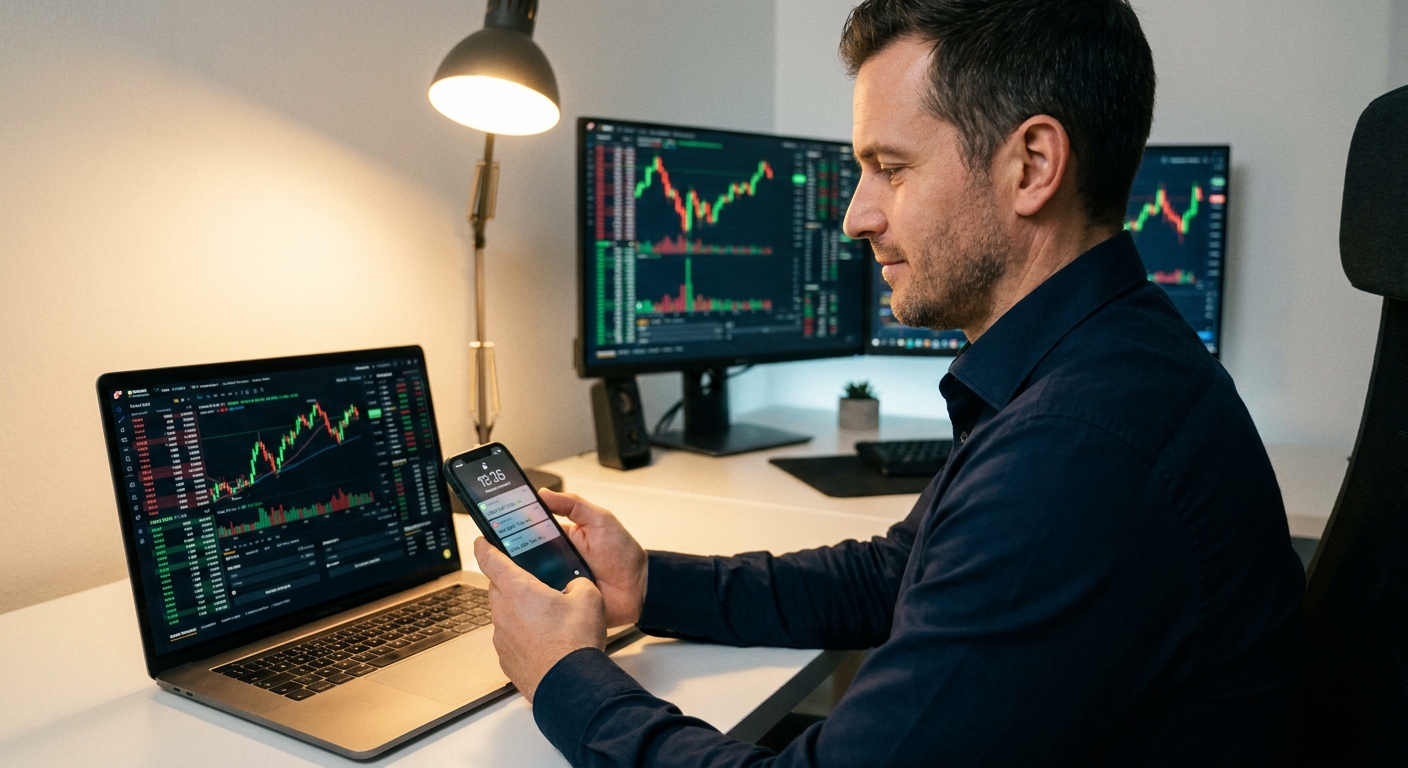
Day trading involves opening and closing positions within the same trading day. Day traders never hold positions overnight, which means they start each morning with a clean slate and zero market exposure. They capitalize on intraday trading opportunities using short timeframes like 1-minute, 5-minute, and 15-minute charts. The goal is to capture small price movements multiple times throughout the session, often executing 5-20+ trades per day.
Day traders focus on technical setups like Opening Range Breakouts (ORB), VWAP reclaims, relative volume (RVOL) spikes, and momentum trading patterns. They need to make quick decisions, often holding positions for minutes or hours rather than days.
Swing trading, by contrast, involves holding positions for multiple days or weeks to capture larger price movements. Swing traders typically hold stocks for 2-10 days, sometimes longer if the trend continues. They analyze daily and weekly charts, looking for breakout trading setups, trend continuations, and multi-day momentum plays.
The philosophical difference runs deeper than just timeframes. Day trading is about precision and speed—catching quick moves and getting out before market close. Swing trading is about patience and positioning—identifying high-probability setups and giving them room to develop over several sessions.
Why does this choice matter so much? Because picking the wrong strategy for your lifestyle leads to burnout, missed opportunities, and poor performance. A busy professional trying to day trade will miss entries while in meetings. A full-time trader attempting swing trading might struggle with the patience required to let positions develop. Your trading style should complement your life, not complicate it.
Time Commitment: How Much Screen Time Do You Really Need?
This is often the deciding factor for most traders, and for good reason. The time demands of day trading versus swing trading are dramatically different.
Day trading time requirements are substantial and non-negotiable. You need to be available during market hours (9:30 AM - 4:00 PM ET) to monitor positions, execute trades, and manage risk. Most successful day traders dedicate 6-8 hours daily to active trading, plus additional time for pre-market preparation and post-market review.
Your typical day trading schedule looks like this:
- Pre-market (7:00-9:30 AM): Review overnight news, scan for gappers, identify potential setups, build your watchlist
- Market open (9:30-10:30 AM): Highest volatility period, most day traders execute their primary trades during this window
- Mid-day (10:30 AM-3:00 PM): Monitor open positions, look for continuation patterns or new setups
- Power hour (3:00-4:00 PM): Final trading window, close all positions before market close
- After-hours (4:00-5:00 PM): Journal trades, review performance, prepare for next session
This schedule makes day trading challenging for anyone with a full-time job or significant daytime commitments. You can't step away for a two-hour meeting when you have open positions that could move against you.
Swing trading time requirements are far more flexible. Most swing traders spend just 30-60 minutes per day on market analysis, typically after market close. Since positions are held for multiple days, you don't need to monitor every tick or react to intraday volatility.
A typical swing trading routine includes:
- Evening analysis (6:00-7:00 PM): Scan for new setups using end-of-day data, review existing positions, set alerts for key price levels
- Morning check (8:00-8:15 AM): Quick review of overnight news and pre-market action on your watchlist
- Occasional intraday checks: Brief glances at positions during lunch or breaks, but not constant monitoring
This makes swing trading ideal for busy professionals, parents, or anyone who can't dedicate full market hours to trading. You can maintain a career while building your trading skills and portfolio. For a detailed approach to swing trading with minimal time commitment, check out our guide on swing trading for busy professionals.
Capital Requirements and Account Minimums
Your available capital plays a huge role in determining which trading style is accessible to you, especially in the United States where regulatory rules create significant barriers for day traders.
The Pattern Day Trader (PDT) rule is the elephant in the room for aspiring day traders. If you execute four or more day trades within five business days in a margin account, you're classified as a pattern day trader and must maintain a minimum account balance of $25,000 at all times. Fall below this threshold, and your broker will restrict your trading until you deposit more funds.
This regulation exists to protect inexperienced traders from excessive risk, but it creates a high barrier to entry. If you don't have $25,000 in trading capital, you have limited options:
- Trade with a cash account (no margin), which limits you to three day trades per week due to settlement rules
- Trade futures or forex, which aren't subject to PDT rules but carry their own risks
- Focus on swing trading instead, which doesn't trigger PDT restrictions
Swing trading capital requirements are much more flexible. Since you're not making multiple intraday trades, you can start with smaller account sizes—some traders begin with $5,000-$10,000 or even less. There's no regulatory minimum, though you'll want enough capital to properly diversify and manage risk.
Beyond regulatory minimums, consider the practical capital needs for each strategy:
Day trading typically requires larger position sizes to make the small percentage gains worthwhile. If you're targeting 0.5-2% gains per trade, you need sufficient capital to generate meaningful dollar profits after commissions. With a $25,000 account, a 1% gain on a full position yields $250—decent, but you need consistent wins to build wealth.
Swing trading targets larger percentage moves (3-10%+ over several days), so smaller position sizes can still generate attractive returns. A $10,000 account capturing a 5% move on a half-position yields $250, similar dollar profit with less capital at risk.
Margin requirements also differ. Day traders often use 4:1 intraday buying power, allowing them to control $100,000 in positions with $25,000 in capital. Swing traders typically use 2:1 overnight margin or trade with cash only to avoid margin calls from overnight gaps.
Risk Profile and Volatility Exposure
Every trading strategy carries risk, but the type of risk differs significantly between day trading and swing trading. Understanding these risk profiles helps you choose the approach that matches your tolerance for uncertainty and stress.
Day trading risk centers on intraday volatility and execution speed. Your primary risks include:
- Rapid price movements: Stocks can move several percentage points in minutes, especially during the opening hour or on news catalysts
- Slippage and execution risk: Fast-moving stocks may fill at worse prices than expected, eating into profits or expanding losses
- Overtrading: The temptation to take marginal setups leads to death by a thousand cuts through commissions and small losses
- Emotional fatigue: Making dozens of quick decisions daily creates mental exhaustion and poor judgment
However, day trading eliminates overnight risk, you're never exposed to after-hours news, earnings surprises, or gap openings. You close every position by 4:00 PM and sleep without market exposure. This is a significant advantage that many day traders value highly.
Swing trading risk involves different challenges:
- Gap risk: Stocks can gap up or down significantly overnight on earnings, news, or market events, blowing through your stop-loss levels
- Overnight exposure: You're at the mercy of after-hours developments, geopolitical events, and macro news
- Patience required: Positions may move against you for days before the setup plays out, testing your conviction
- Larger stop-losses: To give trades room to breathe, swing traders use wider stops (3-8% typically), meaning larger dollar losses when wrong
The psychological stress differs too. Day trading creates acute, intense stress during market hours, you need to stay focused and make rapid decisions. Swing trading creates chronic, lower-grade stress, you're carrying positions overnight and need to resist the urge to micromanage them during the day.
Stop-loss strategies reflect these different risk profiles. Day traders use tight stops (0.25-1% typically) and exit quickly when setups fail. Swing traders use wider stops based on technical levels like support zones or moving averages, accepting larger potential losses in exchange for bigger potential gains.
Neither approach is inherently "safer"—they just expose you to different types of risk. Day trading offers more control and no overnight exposure but requires constant vigilance. Swing trading offers more flexibility and targets larger moves but exposes you to gap risk and multi-day drawdowns.
Technical Setup and Tools You'll Need
The tools and technology requirements for day trading versus swing trading differ substantially, both in terms of cost and complexity.
Day trading tools need to deliver real-time data and lightning-fast execution. Your essential toolkit includes:
- Real-time market scanners: You need scanners that update every second to catch VWAP trading setups, RVOL spikes, and momentum shifts as they happen
- Level 2 data: Shows the order book depth, helping you gauge buying and selling pressure in real-time
- Direct market access (DMA) broker: Fast execution is critical, delays of even seconds can mean the difference between profit and loss
- Multiple monitors: Most day traders use 2-4 screens to monitor charts, scanners, news feeds, and order entry simultaneously
- Reliable internet: Hardwired connection preferred over WiFi to avoid disconnections during critical moments
- Intraday charting platform: Must support 1-minute, 5-minute, and 15-minute timeframes with real-time updates
Day traders rely heavily on technical indicators designed for short timeframes. The most popular include:
- VWAP (Volume Weighted Average Price): Key reference point for institutional trading, used to identify support/resistance and mean reversion opportunities
- RVOL (Relative Volume): Identifies stocks trading with unusual volume, signaling potential momentum plays
- ORB (Opening Range Breakout): Captures breakouts from the first 5-30 minutes of trading
- Moving averages (9 EMA, 20 EMA): Short-period EMAs for trend direction on intraday charts
- RSI and MACD: Momentum oscillators for identifying overbought/oversold conditions
For a deeper dive into these essential indicators, read our comparison of VWAP vs RVOL vs ORB to understand which setups work best for different market conditions.
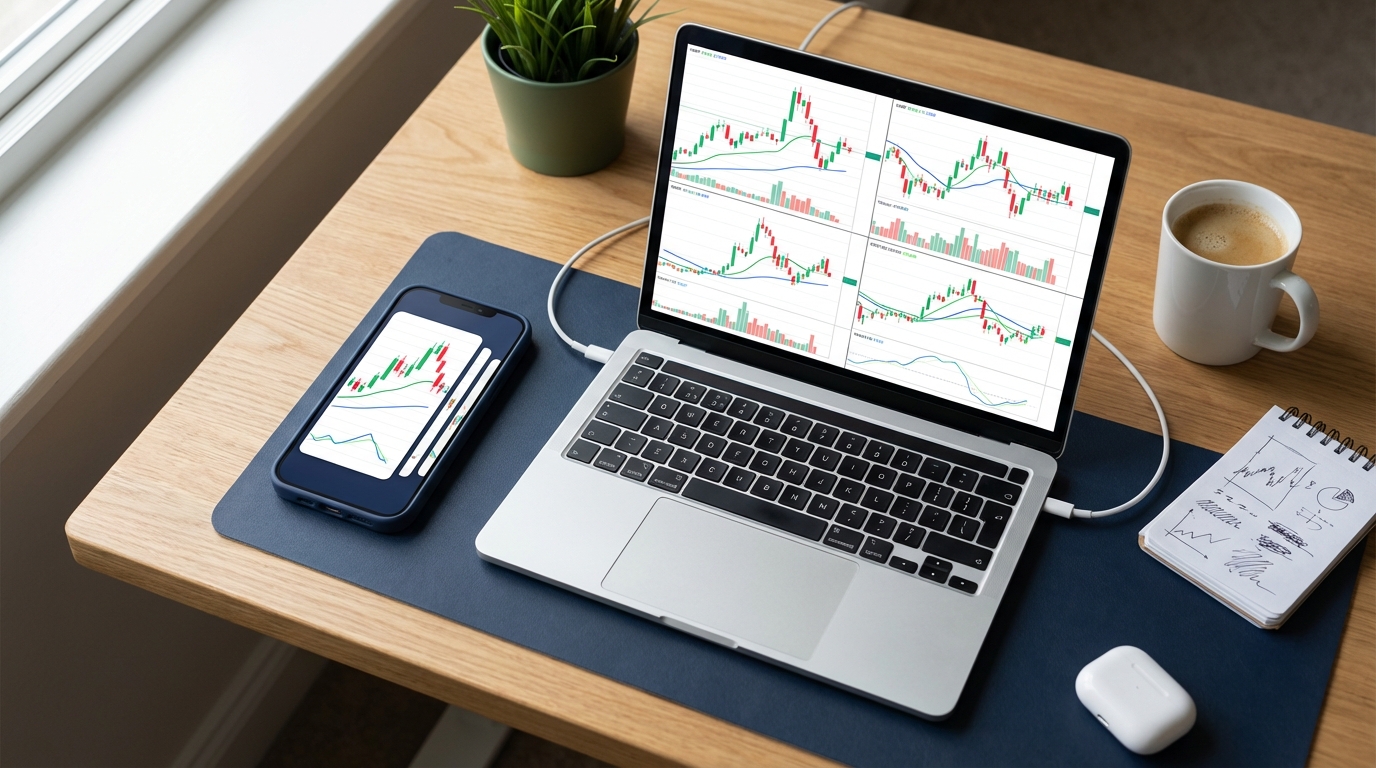
Swing trading tools are less demanding in terms of real-time data but require robust screening and pattern recognition capabilities:
- End-of-day screeners: Scan for breakout trading setups, chart patterns, and momentum plays using daily data
- Daily/weekly charting platform: Focus on longer timeframes to identify trends and key technical levels
- Alert systems: Notify you when stocks on your watchlist hit key price levels or trigger setup criteria
- Single monitor setup: Most swing traders work effectively with just a laptop since they're not monitoring tick-by-tick action
- Mobile access: Ability to check positions and receive alerts on your phone during the day
Swing traders focus on different technical setups that develop over multiple days:
- Breakout patterns: Ascending triangles, bull flags, cup-and-handle formations on daily charts
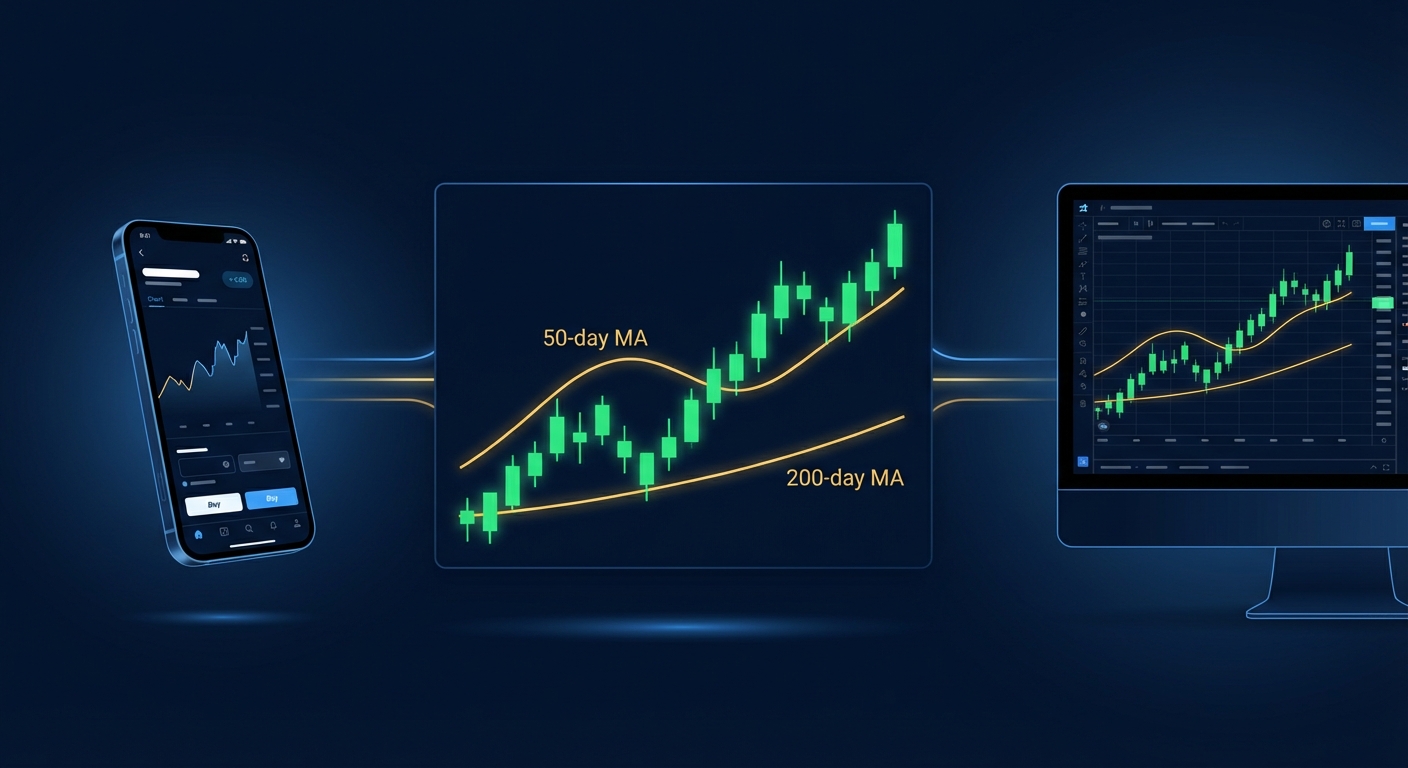
- Moving average crossovers: 50-day and 200-day moving averages for trend identification
- Support and resistance levels: Key price zones that have held multiple times
- Trend channels: Higher highs and higher lows indicating sustained momentum
- Volume analysis: Confirming breakouts with above-average volume
This is where platforms like ChartMath serve both trading styles effectively. For day traders, ChartMath provides real-time scanning across 200+ technical setups with push alerts when stocks match proven patterns like ORB breaks, VWAP reclaims, and RVOL spikes. You get instant notifications on your phone when opportunities appear, even if you step away from your desk.
For swing traders, ChartMath's end-of-day screens identify daily and weekly breakout setups with backtesting strategies showing historical win rates and average returns. You can spend 30 minutes after market close discovering high-probability setups for the next day, then set alerts to notify you when they trigger.
The key differentiator is that ChartMath shows you why each setup matters, with plain-English explanations and backtest data. You're not just getting alerts, you're learning which patterns actually work and understanding the edge behind each trade. Learn more about effective screening in our guide on how to use stock screeners for day trading.
Profit Potential and Win Rate Expectations
Let's talk about the numbers that matter: how much can you realistically make, and how often will you win?
Day trading profit targets focus on small, frequent gains. Successful day traders typically target:
- Win rate: 50-60% (meaning you'll lose on 40-50% of trades)
- Average gain per winning trade: 0.5-2% of position size
- Average loss per losing trade: 0.25-1% of position size
- Trade frequency: 5-20+ trades per day
- Monthly return target: 5-15% of account value for experienced traders
The math works through volume and consistency. If you risk 1% of your account per trade and target a 2:1 reward-to-risk ratio, you need to win just 40% of trades to break even (before commissions). A 55% win rate with proper risk management can generate steady monthly returns.
However, day trading profits are heavily impacted by commissions and fees. If you're paying $5-10 per round trip and making 100 trades per month, that's $500-1,000 in costs. On a $25,000 account, that's 2-4% of your capital going to fees. You need to factor this into your profit expectations.
Swing trading profit targets aim for larger moves with less frequency:
- Win rate: 40-50% (lower than day trading, but larger wins compensate)
- Average gain per winning trade: 5-15% of position size
- Average loss per losing trade: 2-5% of position size
- Trade frequency: 5-15 trades per month
- Monthly return target: 5-12% of account value for experienced traders
Swing trading relies on asymmetric risk-reward ratios. You might win only 45% of the time, but if your average winner makes 10% and your average loser loses 3%, the math works strongly in your favor. One big winner can offset multiple small losses.
Commission impact is much lower for swing traders. With 10 trades per month at $5-10 per round trip, you're paying $50-100 in fees, just 0.5-1% of a $10,000 account. This makes swing trading more accessible for smaller accounts.
Here's the critical insight: backtesting strategies is essential for setting realistic expectations in both approaches. Too many traders enter with unrealistic profit targets based on cherry-picked success stories. The reality is that consistent 5-10% monthly returns are excellent performance that compounds dramatically over time.
ChartMath addresses this by showing actual backtest data for every screen, win rate, average return per trade, sample size, and maximum drawdown. You can see that a particular ORB setup wins 58% of the time with an average gain of 1.2% and average loss of 0.6%. This transparency helps you set realistic expectations and choose setups that match your risk tolerance.
The compounding effect over time is where both strategies shine. A consistent 8% monthly return (achievable for skilled traders) turns $25,000 into $62,000 in one year. The key word is consistent, which requires discipline, proper risk management, and trading setups with proven statistical edges.
Learning Curve and Skill Development
Both day trading and swing trading require significant skill development, but the learning paths differ in important ways.
Day trading learning curve is steep and unforgiving. You need to develop:
- Pattern recognition speed: Identifying setups in real-time as they form, often within seconds
- Quick decision-making: Entering and exiting positions without hesitation or second-guessing
- Emotional control: Managing the psychological roller coaster of rapid wins and losses
- Risk management discipline: Cutting losses quickly before they spiral out of control
- Market feel: Understanding intraday momentum, volume patterns, and price action nuances
The challenge is that day trading provides immediate, often harsh feedback. Make a mistake, and you'll know within minutes as your position moves against you. This accelerated feedback loop can be educational, but it's also expensive. Many aspiring day traders blow through their first account learning lessons that could have been learned through simulation or education.
Common beginner mistakes in day trading include:
- Overtrading: Taking every setup instead of waiting for high-probability opportunities
- Revenge trading: Trying to immediately recover losses by taking impulsive trades
- Position sizing errors: Risking too much on single trades, leading to catastrophic losses
- Holding losers too long: Hoping positions will recover instead of cutting losses at predetermined stops
- Chasing momentum: Entering after the move has already happened, buying tops and selling bottoms
Swing trading learning curve is more gradual but requires different skills:
- Patience and discipline: Waiting for setups to fully develop and resisting the urge to micromanage positions
- Macro analysis: Understanding broader market trends, sector rotation, and multi-day momentum
- Position management: Scaling in and out of positions, adjusting stops as trades develop
- Fundamental awareness: Knowing when earnings are scheduled, understanding catalysts that drive multi-day moves
- Chart pattern recognition: Identifying formations like flags, triangles, and channels on daily timeframes
Swing trading provides slower feedback, which can be both a blessing and a curse. You have more time to think through decisions, but you also need to tolerate uncertainty as positions develop over days. The delayed gratification can be psychologically challenging for traders who crave immediate results.
Common beginner mistakes in swing trading include:
- Exiting winners too early: Taking profits at the first sign of resistance instead of letting trends develop
- Ignoring stop-losses: Holding losing positions too long, hoping they'll recover
- Overanalyzing: Paralysis by analysis, missing entries while waiting for "perfect" setups
- Checking positions too frequently: Reacting to intraday noise instead of focusing on daily closes
- Poor position sizing: Going all-in on single trades instead of building positions gradually
For both approaches, practice without risking capital is essential. Paper trading (simulated trading) allows you to test strategies and develop skills before putting real money on the line. However, paper trading can't replicate the emotional pressure of real trading, it's easy to follow your rules when there's no money at risk.
A better approach is to start with small position sizes (risking $50-100 per trade) while you develop your skills. The emotional experience of real money, even small amounts, teaches lessons that simulation can't. As your win rate and consistency improve, gradually increase position sizes.
Educational resources matter too. For day trading, focus on learning price action, volume analysis, and intraday momentum indicators. For swing trading, study chart patterns, trend analysis, and multi-timeframe confirmation. Platforms like ChartMath serve as educational tools by showing you why setups work, with backtest data and plain-English explanations that accelerate your learning curve.
Which Trading Style Fits Your Lifestyle?
Now comes the moment of truth: which approach aligns with your unique situation? Let's create a decision framework based on the key factors we've discussed.
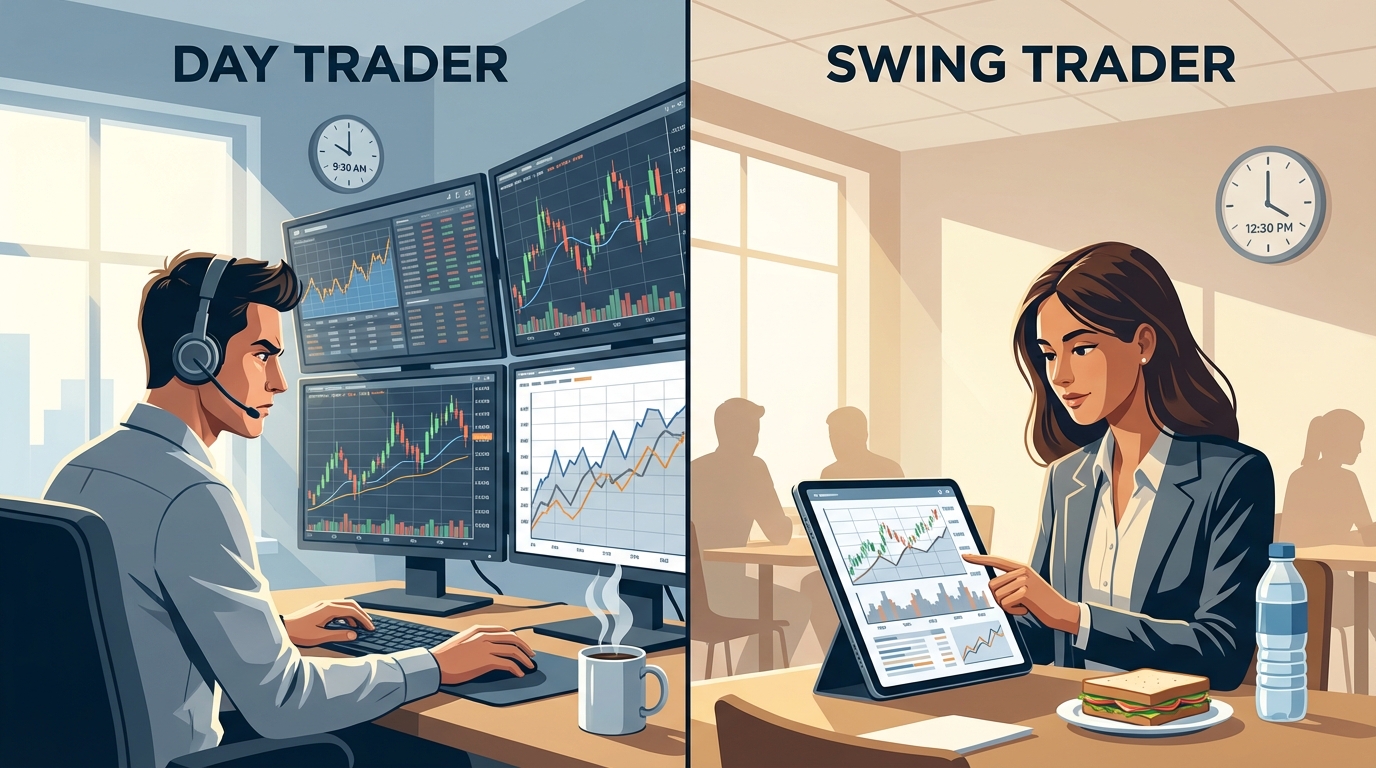
Choose day trading if you:
- Can dedicate 6-8 hours daily to active trading during market hours
- Have at least $25,000 in trading capital (or are willing to trade futures/forex)
- Thrive in fast-paced, high-pressure environments
- Make quick decisions confidently without second-guessing
- Prefer closing all positions daily and sleeping without market exposure
- Have a high tolerance for screen time and intense focus
- Can handle the emotional swings of rapid wins and losses
- Want immediate feedback on your trading decisions
- Are willing to invest in professional-grade tools and technology
Choose swing trading if you:
- Have limited time during market hours due to work or other commitments
- Can dedicate 30-60 minutes daily for analysis, typically after market close
- Have smaller trading capital (can start with $5,000-$10,000)
- Prefer strategic, patient approaches over rapid-fire decision-making
- Can tolerate overnight risk and multi-day position uncertainty
- Want to target larger percentage gains with less frequent trading
- Prefer a more sustainable, less stressful trading lifestyle
- Are willing to wait days or weeks for setups to fully develop
- Can resist the temptation to micromanage positions during the day
Your personality type matters as much as your schedule. Day trading attracts high-energy, competitive personalities who enjoy the thrill of rapid decision-making. Think of day traders as sprinters, intense bursts of focused energy. Swing trading attracts strategic, patient thinkers who prefer positioning over reaction. Think of swing traders as marathon runners, steady, sustainable pace.
Can you combine both approaches? Absolutely. Many experienced traders use a hybrid strategy:
- Swing trade core positions on daily timeframes for larger moves
- Day trade around those positions on intraday timeframes for additional income
- Use different accounts or position sizing to separate the two strategies
- Apply day trading tactics during high-volatility periods, swing trading during consolidation
However, beginners should master one approach before attempting to combine them. Trying to do both simultaneously often leads to confusion, mixed signals, and poor execution in both strategies.
The bottom line: your trading style should fit your life, not force you to reshape your life around trading. If you're constantly stressed, missing entries, or struggling to maintain consistency, you've likely chosen the wrong approach for your current situation. Be honest with yourself about your available time, capital, and psychological makeup.
Getting Started: Your Next Steps
You've made it through the comprehensive comparison. Now it's time to take action and start building your trading skills with the approach that fits your lifestyle.
If you're pursuing day trading, here are your next steps:
- Build your capital: If you don't have $25,000, start saving or consider trading futures/forex while you build your account
- Set up your technology: Invest in a reliable broker with fast execution, real-time data feeds, and professional charting tools
- Learn the core setups: Focus on mastering 2-3 high-probability patterns like ORB, VWAP reclaims, or momentum breakouts before expanding your playbook
- Paper trade for 30 days: Test your strategies in simulation to develop pattern recognition and execution speed
- Start small with real money: Begin with small position sizes (risking $50-100 per trade) to experience real emotional pressure
- Use screening tools: Implement a real-time scanner to identify setups as they form, you can't watch every stock manually
- Journal every trade: Track your entries, exits, emotions, and lessons learned to identify patterns in your performance
For day traders, real-time alerts are non-negotiable. You need to know the moment a stock breaks its opening range or reclaims VWAP. Watch a demo of how ChartMath's real-time scanning delivers these opportunities to your phone with backtest data showing which setups actually work. The platform monitors 200+ technical screens continuously so you don't have to manually refresh scanners all day.
If you're pursuing swing trading, here are your next steps:
- Open a brokerage account: Choose a broker with low commissions and good charting tools, you don't need the premium features day traders require
- Learn chart patterns: Study the classic formations like bull flags, ascending triangles, and cup-and-handle patterns on daily charts
- Build your watchlist: Identify 20-30 stocks with strong trends, good liquidity, and clean technical patterns
- Set up end-of-day screening: Create a routine for scanning the market after close to identify new setups
- Start with 1-2 positions: Don't try to manage 10 positions while you're learning, focus on quality over quantity
- Set price alerts: Use alerts to notify you when stocks hit key levels instead of checking charts constantly
- Review weekly performance: Analyze your trades every weekend to identify what's working and what needs adjustment
Swing traders benefit enormously from end-of-day screening with backtest data. You want to see which breakout setups have historically worked, what the average return looks like, and what the win rate is before risking capital. Download the ChartMath app to access 200+ pre-built screens with historical performance data, then set alerts for when your favorite stocks trigger high-probability setups.
For both approaches, here's how to build your watchlist and track performance:
Your watchlist is your trading universe, the stocks you monitor daily for setup opportunities. Start with liquid, volatile stocks that move enough to generate profits but aren't so erratic that they're unpredictable. For day traders, focus on stocks with average daily volume above 1 million shares and average true range (ATR) above $1. For swing traders, look for stocks in strong trends with clear support and resistance levels.
Use a stock market app or stock screening app to filter candidates based on your criteria. ChartMath's discover feed shows you ranked setups across the entire market, sorted by quality and freshness. You can swipe through opportunities like a TikTok feed, save the best ones to your watchlist, and get alerted when they trigger.
Performance tracking is essential for improvement. Track these metrics for every trade:
- Entry price and time
- Exit price and time
- Position size and risk amount
- Setup type (ORB, VWAP reclaim, breakout, etc.)
- Profit/loss in dollars and percentage
- What went right or wrong
- Emotional state during the trade
After 20-30 trades, patterns will emerge. You might discover that you win 70% of the time on VWAP reclaims but only 40% on breakouts. Or that you hold winners too long and cut losers too early. This data-driven approach to improvement separates successful traders from those who repeat the same mistakes indefinitely.
The beauty of modern trading tools is that you don't need to build everything from scratch. Platforms like ChartMath provide the screening, backtesting, and alerting infrastructure so you can focus on execution and risk management. Whether you're day trading ORB setups on 5-minute charts or swing trading breakouts on daily charts, having proven setups delivered to your phone with historical performance data accelerates your learning curve dramatically.
Ready to discover which technical setups match your trading style? Try the web-based screener to explore 200+ pre-built screens with backtest data showing win rates and average returns. See which patterns align with your risk tolerance and time commitment, then start building your watchlist of high-probability opportunities.
The choice between day trading and swing trading isn't about which is "better"—it's about which fits your schedule, capital, and personality. Both approaches can generate consistent profits when executed with discipline, proper risk management, and proven setups. The traders who succeed are those who choose the strategy that complements their lifestyle rather than fighting against it.
Start with one approach, master the fundamentals, and give yourself at least 3-6 months to develop consistency before judging your results. Trading is a skill that improves with deliberate practice, honest self-assessment, and continuous learning. Whether you're catching intraday momentum plays or positioning for multi-day breakouts, the key is finding setups with statistical edges and executing them with unwavering discipline.
Your trading journey starts now. Choose your path, commit to the process, and remember that every successful trader started exactly where you are today, with a decision to take that first step.

See these setups live in ChartMath
200+ curated screens with backtest data. Free. No credit card required.