PDT Rule Eliminated 2026: What Changed for Day Traders

June 4, 2026 was a quiet Wednesday. No press conference, no market-moving headline. But buried in a FINRA regulatory notice, a rule that had blocked millions of retail traders from freely day-trading a small account for over two decades was officially eliminated.
The Pattern Day Trader (PDT) rule is gone. Not reformed. Not lowered. Gone. If you've been waiting for this moment, here's exactly what changed, what didn't, and the harder question nobody is asking loudly enough: now that the gate is open, do you actually have an edge to walk through it?
1. What Actually Changed on June 4, 2026
FINRA published Regulatory Notice 26-10, announcing amendments to FINRA Rule 4210 that took effect June 4, 2026. Brokers have until October 20, 2027 to complete their implementation, so the rollout is happening broker-by-broker. Some are already live. Others are still phasing in. Check with your specific broker before assuming the new rules apply to your account today.
Here is what was removed:
- The "Pattern Day Trader" designation itself
- The day-trade count test: the old rule flagged you as a PDT if you executed 4 or more day trades in any 5 business days in a margin account (which practically capped you at 3 day trades per rolling 5-day window)
- The $25,000 minimum equity requirement that PDT-flagged accounts had to maintain
Here is what replaces it:
Instead of counting trades, brokers now operate a real-time intraday margin framework. Your broker monitors whether your account equity covers your intraday position exposure at any given moment. If your positions exceed what your equity can support, the broker can restrict or close positions. The focus shifts from "how many trades did you make this week?" to "can your account actually cover what you're holding right now?"
That is a meaningful structural change. The old rule was blunt: hit the trade count, get flagged, face the $25k wall. The new framework is dynamic: your buying power is tied to your real-time equity and the margin your broker extends, not an arbitrary weekly counter.
Key takeaway: The PDT designation, the day-trade count test, and the $25,000 minimum are all eliminated per FINRA Notice 26-10. What replaces them is a real-time intraday margin system. Implementation is phased through October 20, 2027.
2. The $2,000 Margin Minimum: Not New, Not Gone
You've probably seen posts claiming there's a "new $2,000 rule." There isn't. The $2,000 figure is the long-standing standard minimum equity required to open and use a margin account under Reg T and FINRA rules. It has existed for decades. The PDT elimination didn't create it.
What changed is context. Before June 4, 2026, the $25,000 PDT requirement was the dominant equity gate for anyone who wanted to day-trade a margin account. With that gate removed, the $2,000 margin minimum is simply the only equity floor left. It was always there. It just wasn't the binding constraint before.
A few other things that have not changed and are worth stating clearly:
- Cash accounts were never subject to PDT. If you traded a cash account, the PDT rule never applied to you. That's still true. Cash accounts have their own settlement constraints (T+1 settlement under current rules), but no PDT designation ever existed for them.
- Swing trades were never day trades. Overnight holds and multi-day positions never counted against the PDT day-trade tally. If you held a position from Tuesday to Thursday, that was never a day trade under the old rule, and the new framework doesn't change that either.
- The $2,000 minimum is a margin account floor, not a day-trading-specific cap. It applies to any margin account, regardless of trading style.
So if someone tells you there's a "new $2k rule for day traders," correct them. The $2,000 margin minimum still applies, as it always has. It's just more visible now that the $25k wall is gone.
3. Can You Day-Trade a Small Account Now?
Technically, yes. If your margin account is above $2,000 and your broker has completed its phase-in of the new rules, you can execute as many day trades as your intraday margin supports. The count limit is gone. The $25k floor is gone.
The practical reality is more nuanced. Your broker's intraday margin framework determines how much buying power you actually have. A $3,000 account with 4:1 intraday margin gives you $12,000 in intraday buying power. That sounds like a lot until you realize that a single bad trade on a volatile stock can wipe out a significant percentage of a thin account. The math of small-account trading hasn't changed just because a regulatory label was removed.
The harder question is whether you should day-trade a small account. That's where most of the conversation is missing the point.
Access is not edge. The PDT rule was a barrier. Removing it gives you access. But access to a market where the majority of retail day traders lose money is not the same as having a reason to expect you'll be in the minority that doesn't. The rule change doesn't alter the underlying statistics of intraday trading. It just removes one of the guardrails.
4. The Hidden Cost of New Freedom: Overtrading a Thin Account
The PDT rule was frustrating. It was blunt, it was arbitrary, and it disproportionately affected traders who couldn't afford to park $25,000 in a brokerage account. Those criticisms are fair.
But the rule also forced a kind of discipline. When you could only make three day trades in a five-day window, you had to be selective. You couldn't chase every setup. You had to decide which three trades were worth it. That constraint, annoying as it was, filtered out a lot of impulsive, low-quality entries.
Without that guardrail, the temptation to overtrade is real. And overtrading a thin account is one of the fastest ways to blow it up. Here's why the math works against you:
- A 10% loss on a $5,000 account requires an 11.1% gain just to get back to even.
- A 25% loss requires a 33.3% gain to recover.
- A 50% loss requires a 100% gain to recover.
Each bad trade doesn't just cost you money. It raises the percentage return you need to get back to where you started. On a small account, where commissions represent a larger slice of each trade and emotional pressure is higher, this math compounds quickly.
The PDT rule's elimination is genuinely good news for traders who have a system, manage risk properly, and were simply blocked by an arbitrary equity threshold. For traders who don't yet have those things, the new freedom is a faster road to the same destination: a depleted account and a lesson learned the expensive way.
If you want to understand how to build the kind of systematic approach that makes the new freedom actually useful, the swing trading with a full-time job framework is a good place to start, because the principles apply whether you're holding overnight or intraday.
5. Why Swing Trading Still Has the Edge for Small Accounts
Here's something worth sitting with: swing trading was never restricted by the PDT rule. Overnight holds, two-day trades, week-long positions — none of those ever counted as day trades. The PDT rule only applied to positions opened and closed within the same trading day in a margin account.
That means swing traders with small accounts had full freedom the entire time. And the PDT elimination doesn't change the fundamental advantages that swing trading offers a small account:
- Time to research. You can identify a setup in the evening, verify it against backtested data, plan your entry and exit, and execute the next morning without real-time pressure.
- Lower transaction costs relative to position size. Fewer trades mean commissions eat a smaller percentage of your returns.
- Compatibility with a day job. You don't need to watch charts all day. You need a system that alerts you when a setup forms, and the discipline to act on it or pass.
- Documented edge. Swing setups on daily and weekly timeframes have longer historical sample sizes, which means backtested Win Rate and Average Return figures are more statistically meaningful than intraday setups with smaller sample sizes.
The PDT elimination is a genuine win for retail traders. But it doesn't make day trading easier. It removes one barrier. The other barriers — the speed advantage of institutional algorithms, the information asymmetry, the emotional pressure of watching a position move against you in real time — are all still there.
For most traders with a small account and a day job, swing trading on the daily timeframe remains the higher-probability path. The daily chart swing trade scanner workflow covers exactly how to build that process.
6. How to Build a Systematic Edge Now That the Gate Is Open
Whether you plan to day-trade, swing trade, or some combination of both, the PDT elimination changes one thing: the regulatory constraint. It doesn't change what you need to trade profitably. Here's a five-step framework for building a systematic edge with a small account in the post-PDT environment.
Step 1: Know Your Setup Before You Risk Capital
Every trade you take should be based on a defined setup with a documented historical edge. That means knowing the Win Rate and Average Return of the pattern you're trading across a meaningful sample of historical occurrences, not just the last three times it worked for you.
Gut feel is not a system. "This chart looks good" is not a system. A system is: "When X condition is met on Y timeframe, the historical Win Rate is Z% over N occurrences, with an average return of W%." That's the baseline you need before you put capital at risk.
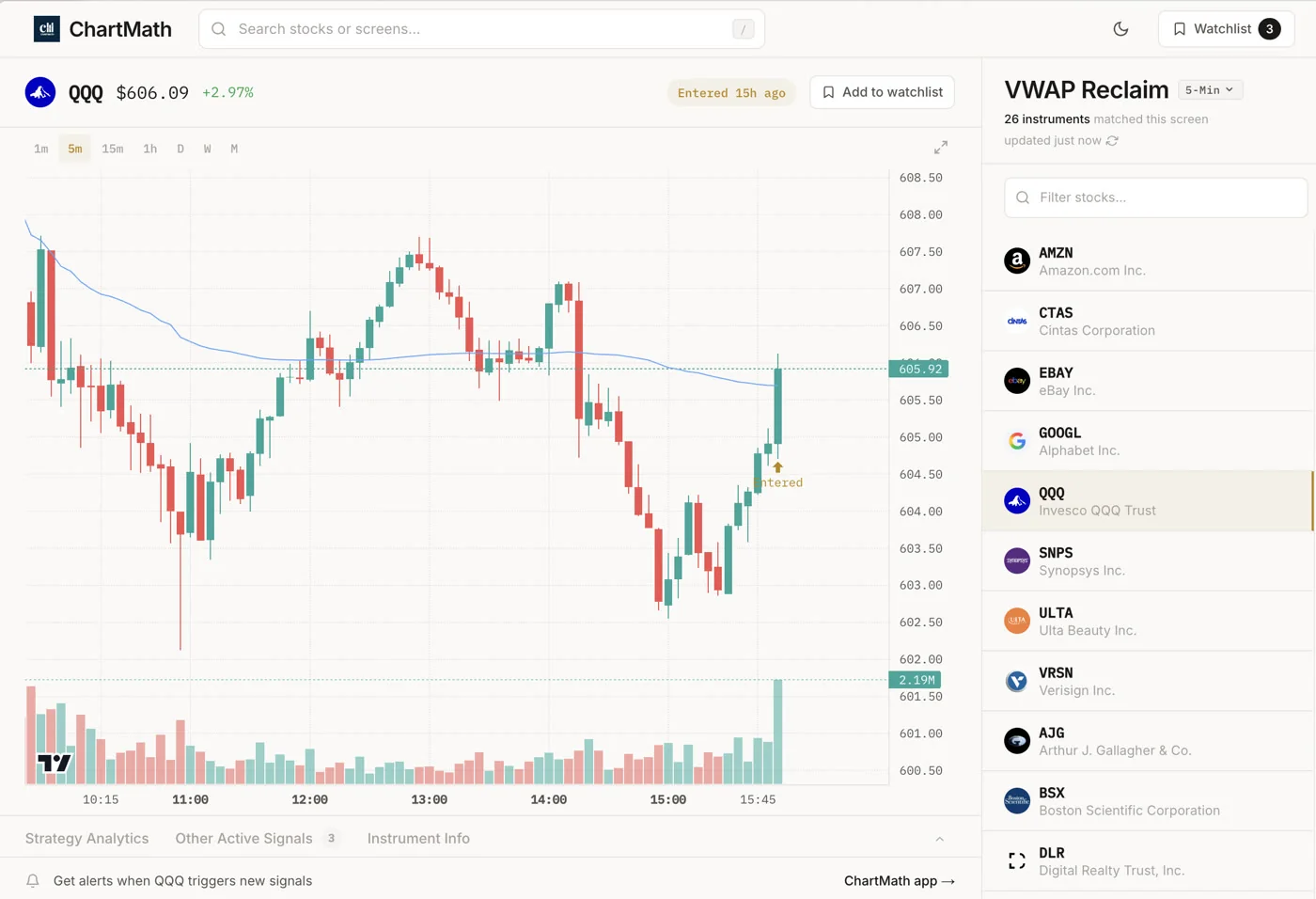
Tools like ChartMath's 200+ curated technical screens show you exactly that: Win Rate and Average Return on every setup, pre-calculated, no Pine Script required. You don't build the screens. You browse them, find the ones with documented edge on the timeframe you trade, and use those as your filter. For a deeper look at how backtested win rates should inform your trade selection, the guide on building winning backtesting strategies is worth reading.
Step 2: Size Correctly, Every Time
Risk 1-2% of your account per trade. Not per day. Per trade. On a $5,000 account, that's $50-$100 of risk per position. This feels small. It is small. That's the point.
Proper position sizing is what keeps a string of losing trades from ending your account. It also keeps you emotionally neutral enough to follow your system rather than panic-exit or revenge-trade. The math of compounding works in your favor when you stay in the game long enough for your edge to express itself across a large sample of trades.
Step 3: Use Alerts, Not Chart-Watching
Staring at charts all day is not a trading strategy. It's a recipe for impulsive decisions driven by short-term price noise. A better approach: define your setups in advance, set alerts that fire when those setups form, and then verify the signal before acting.
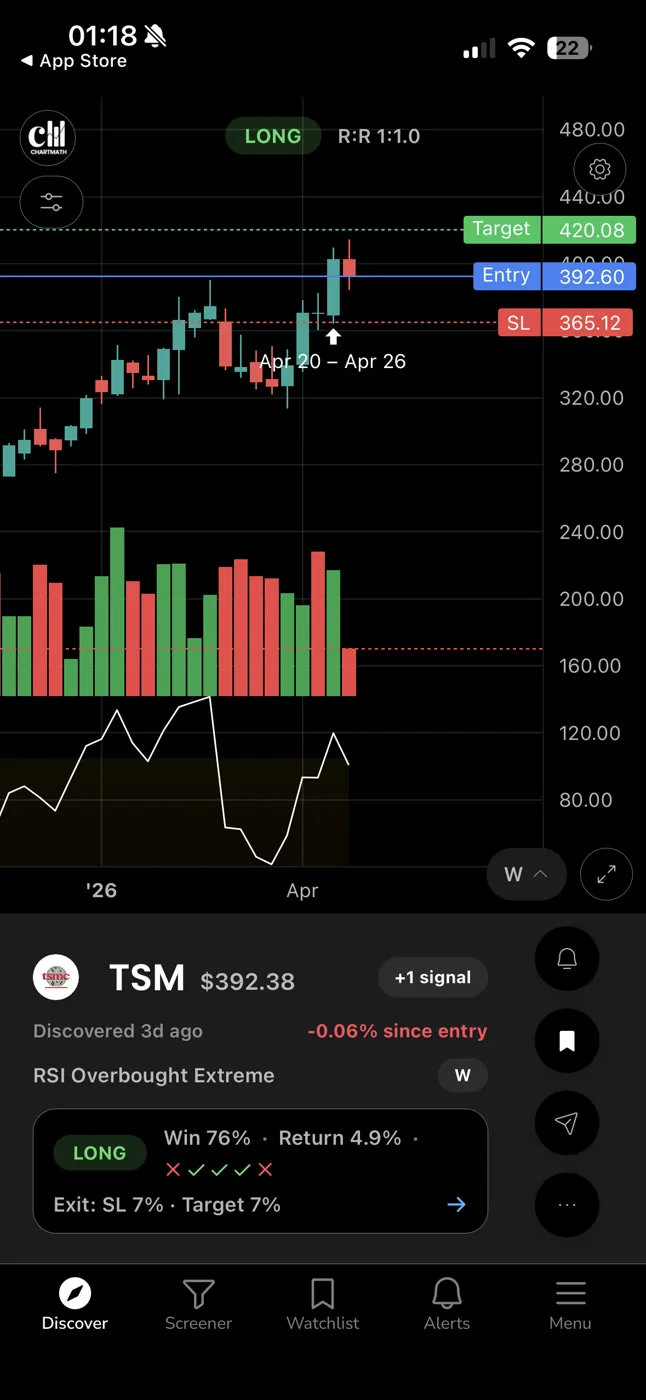
ChartMath sends push and in-app alerts the moment a stock enters one of its 200+ curated screens. Each alert carries the ticker, the timeframe, and the screen name, and the screen itself states its entry rule in plain English alongside a short description and its backtested Win Rate. You get the signal without the screen-watching. Then you decide whether to act. That's the copilot model: the app surfaces the setup, you make the call, you execute in your own broker.
For traders who want to understand how to integrate that kind of alert workflow into a broader process, the post on trading stocks without watching the screen all day covers the full approach.
Step 4: Track Every Trade
Without a trade log, you cannot tell whether your edge is real or whether you've just been lucky. Track entry price, exit price, setup name, timeframe, and outcome for every trade. After 30-50 trades, you'll have enough data to compare your actual results against the historical Win Rate of the setups you're using.
If your results are significantly worse than the historical baseline, the problem is execution, not the setup. If they're in line, you have confirmation that your system works. Either way, you have data instead of feelings.
Step 5: Start on the Daily Timeframe
The PDT elimination makes intraday trading accessible. That doesn't mean intraday trading is where you should start. Daily and weekly timeframes give you more time to think, larger historical sample sizes for backtested setups, and lower sensitivity to the kind of millisecond noise that makes intraday trading genuinely difficult.
Build your system on the daily timeframe first. Prove your edge there. Then, if you want to add intraday setups, you'll have the discipline and the process to do it without blowing up your account in the first month.
How ChartMath Fits Into This Framework
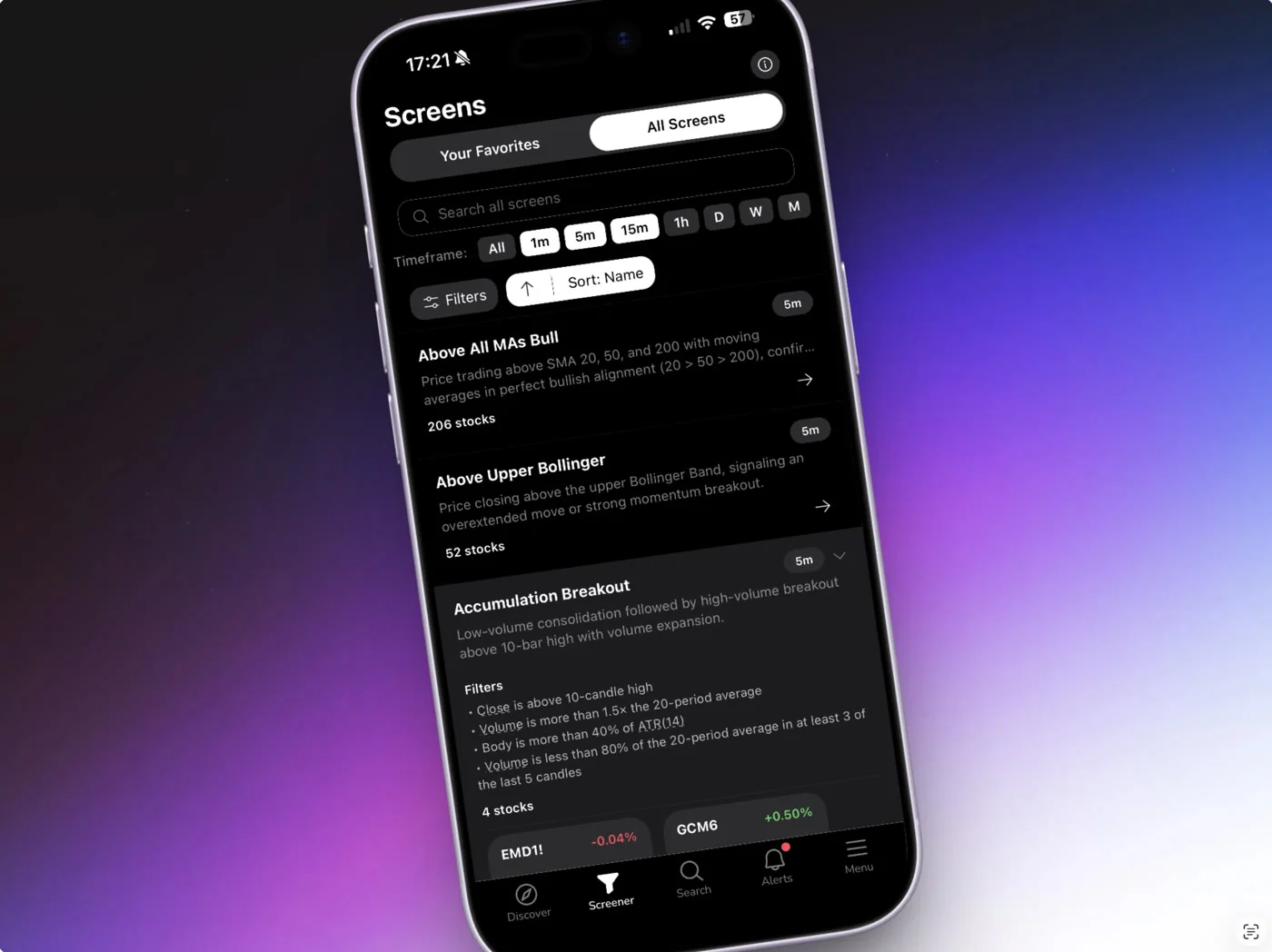
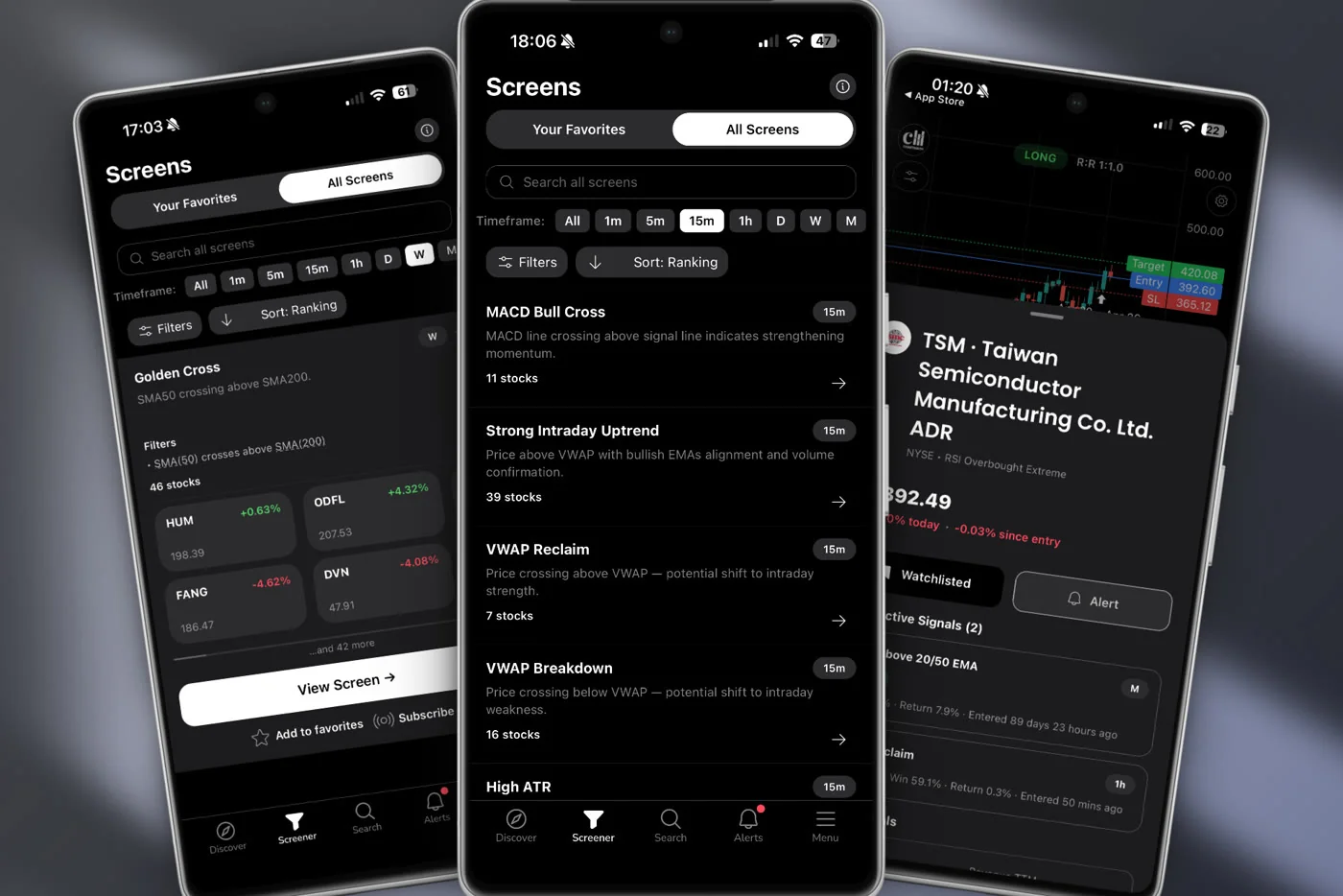
ChartMath is built for exactly this kind of systematic approach. It scans 500+ US equities, 100 crypto pairs, and 11 US futures across 200+ curated technical screens and 7 timeframes (1-minute, 5-minute, 15-minute, 1-hour, Daily, Weekly, Monthly). Every screen shows its historical Win Rate and Average Return. No Pine Script. No coding. No custom screen builder needed.
The Discover feed surfaces entry cards: each one tells you the symbol and the matched screen, and shows that screen's rule in plain English alongside a short description and its backtested Win Rate. The Screener lets you browse all 200+ screens and see which stocks currently match. Alerts fire via push and in-app notifications the moment a setup forms on any screen you've favorited or any ticker in your watchlist.
It's a copilot, not autopilot. ChartMath doesn't place trades. It doesn't connect to your broker. It surfaces the setup, explains the edge, and lets you decide. You execute in your own brokerage. That's the right model for a trader who wants to be systematic without outsourcing their judgment to an algorithm.
ChartMath is free: every screen, every backtest, and every alert. Download the app on iOS or Android and start browsing the screens before you risk a dollar.
7. Frequently Asked Questions
Is the PDT rule completely gone?
Yes. Per FINRA Regulatory Notice 26-10, the Pattern Day Trader designation, the day-trade count test, and the $25,000 minimum equity requirement are all eliminated, effective June 4, 2026. Brokers are phasing in implementation through October 20, 2027.
When does the change take effect at my broker?
It depends on your broker. The effective date is June 4, 2026, but brokers have until October 20, 2027 to complete implementation. Some brokers are already live with the new rules. Others are still in the process. Contact your broker directly to confirm your account's current status.
Does this affect cash accounts?
No. Cash accounts were never subject to the PDT rule. The PDT designation only ever applied to margin accounts. Cash accounts have their own settlement constraints, but the PDT elimination doesn't change anything for cash account holders.
Do I still need $2,000 to day-trade?
Yes. The $2,000 minimum equity requirement for a margin account is a long-standing Reg T / FINRA standard. It was not created by the PDT elimination. With the $25,000 PDT floor removed, the $2,000 margin minimum is simply the only equity gate left for day-trading a margin account.
Does this change the rules for swing trading?
No. Overnight holds and multi-day positions were never classified as day trades under the PDT rule. Swing trading was always unrestricted by PDT. The elimination doesn't change anything for swing traders.
Should I start day trading now that the PDT rule is gone?
Only if you have a documented, backtested system and proper risk management in place. The PDT elimination removes a regulatory barrier. It doesn't change the underlying difficulty of intraday trading or the statistics of retail trader outcomes. If you don't yet have a systematic approach, the smarter move is to build one first, starting with swing setups on the daily timeframe, before adding intraday complexity.
What's the best way to find setups with a documented edge?
Use a screener that shows historical Win Rate and Average Return on every setup, not just a list of tickers. ChartMath's 200+ curated technical screens do exactly that, across 7 timeframes, with no coding required. You can also browse the screens on the web before downloading the app. For a deeper look at how to use stock screeners effectively for day trading, the guide on using stock screeners for day trading in 2026 covers the full process.
The Bottom Line
The PDT rule's elimination is the most significant change to US retail day-trading regulation in over two decades. The $25,000 floor is gone. The trade-count cap is gone. The Pattern Day Trader designation is gone. For traders who had a system and were simply blocked by an arbitrary equity threshold, this is genuinely good news.
For everyone else, the honest answer is: the gate opened, but the road is the same. Intraday trading is still fast, still competitive, and still statistically difficult for retail traders without a systematic edge. The PDT rule forced selectivity. Without it, you have to supply that discipline yourself.
The traders who will benefit most from this change are the ones who treat it as an opportunity to apply a real system, not as permission to trade more. Build your setups around documented Win Rate and Average Return. Size every trade at 1-2% of account. Use alerts to catch entries without watching charts all day. Track every trade. Start on the daily timeframe and earn your way to intraday.
If you want a systematic starting point, download ChartMath and browse the 200+ backtested screens before you place a single trade. Every screen shows its historical edge and states its rule in plain English. The first month is $1 on monthly and annual plans. That's the kind of copilot a small account needs right now.
Disclaimer: This article is for educational purposes only and does not constitute financial or investment advice. Backtested results are historical and do not guarantee future performance. Backtests use bar-close entries and do not model commissions, slippage, or spread. Always consult a qualified financial professional before making investment decisions.

See these setups live in ChartMath
200+ curated screens with backtest data. Free. No credit card required.