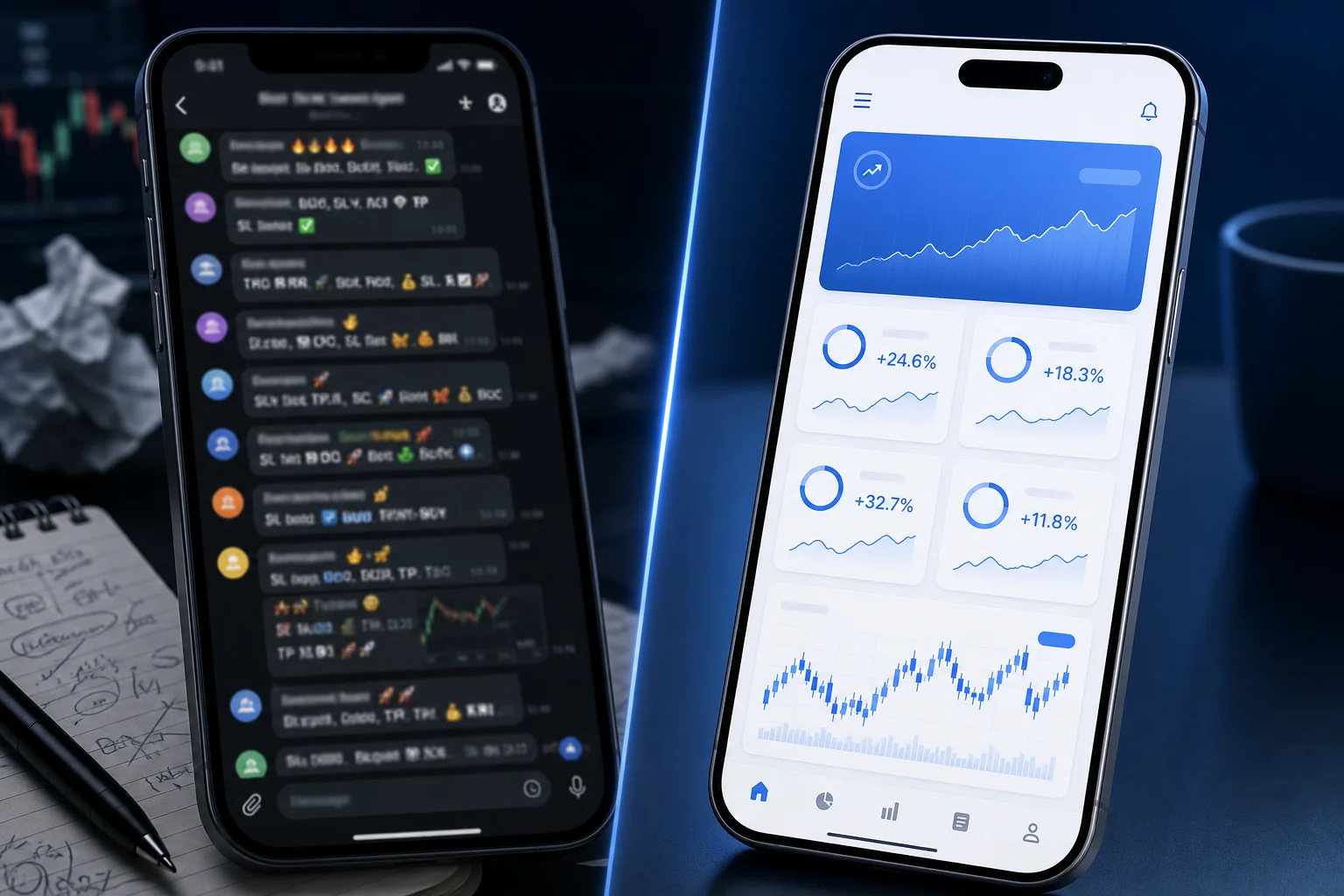
Discord Trading Signals vs Backtested Screener: Which Wins?
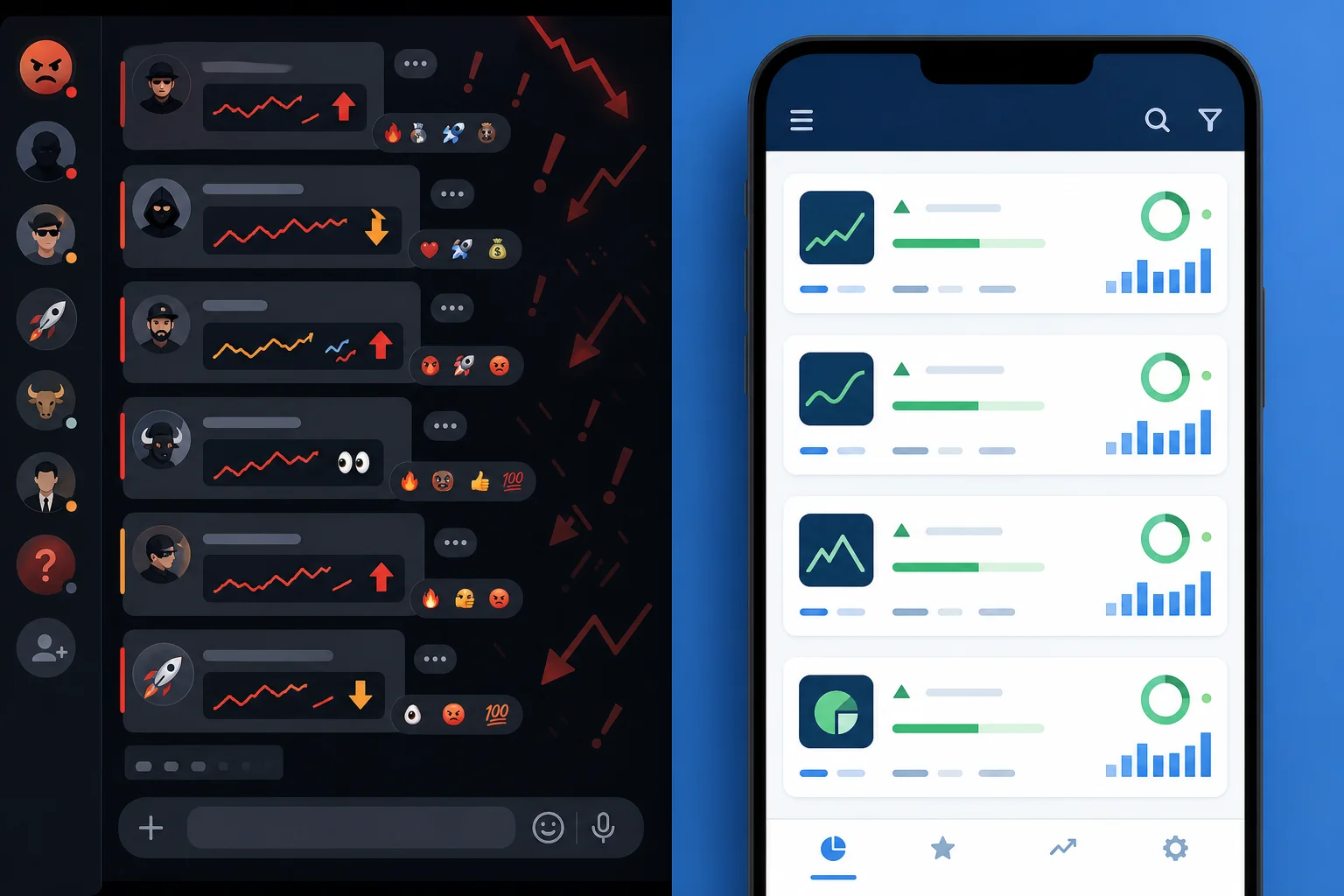
A trader posts a ticker in a Discord server at 10:43 AM. By 10:44 AM, 200 people have seen it. By 10:45 AM, some of them have already bought. By the time you read it on your lunch break, the entry is gone and the chart looks nothing like the screenshot attached to the call. Sound familiar?
That scenario plays out in signal groups every single trading day. The frustrating part isn't that the setup was wrong. It's that you have no way to know whether it was right or wrong in any systematic sense, because there's no auditable track record behind it. That's the core problem this post addresses: not whether Discord trading signals are "good" or "bad," but whether they can make you a systematic trader. And whether a backtested stock screener can do what a signal group structurally cannot.
The Real Question Behind the Comparison
Most comparisons between signal groups and screeners get framed as a convenience question: which one is easier to use? That's the wrong frame. The right question is: which one gives you a repeatable, auditable edge?
A repeatable edge requires three things. First, a defined set of rules that tell you exactly when a setup qualifies. Second, a historical track record that shows how those rules performed across a meaningful sample. Third, a risk framework that tells you how to size the trade and where to exit.
Signal groups can occasionally deliver the first. They almost never deliver the second or third. A backtested screener, by design, delivers all three. That's not a marketing claim. It's a structural difference in how the two tools work.
What Discord Trading Signals Actually Are
A Discord trading signal is, at its simplest, a person posting a ticker with an entry price, a target, and sometimes a stop. The format varies. Some groups include a chart screenshot. Some include a brief rationale. Many include nothing except the ticker and a price level.
These groups range from free hobbyist servers run by retail traders to paid "premium" communities charging monthly fees. The quality varies just as widely. Some operators are genuinely skilled traders sharing their own process. Others are running paid promotions, front-running their own calls, or simply recycling setups they found elsewhere.
The critical issue isn't intent. It's verifiability. The SEC has published investor alerts specifically about social media investment advice, noting that unregistered individuals providing investment recommendations may be violating securities law, and that pump-and-dump schemes frequently operate through exactly these channels. Even when a signal group is run in good faith, you have no standardized way to verify the operator's track record, their methodology, or their incentives.
You're trusting a person you can't audit, using rules you can't see, with a history you can't verify. That's not a system. That's a bet on someone else's judgment.
Five Structural Problems With Signal Groups
The problems with signal groups aren't about the people running them. They're structural. Even a well-intentioned, skilled operator running a signal group faces these five limitations by design.
- No verifiable track record. Win rates in signal groups are self-reported, cherry-picked, or absent entirely. There's no independent audit. There's no sample size. There's no way to distinguish a 60% win rate from a fabricated one. Without a verifiable track record, you can't size positions rationally or know whether you're following a real edge.
- No rule transparency. When a signal fires, you don't know what filter criteria generated it. Was it a VWAP reclaim? A 52-week high breakout? A momentum squeeze? Without knowing the rules, you can't evaluate whether the setup fits your own strategy, and you can't learn from it. You're just copying a call you don't understand.
- Promotion risk. Some signals are paid promotions. Some operators take a position before posting. The SEC's investor education resources describe pump-and-dump schemes as a persistent risk in retail trading communities. Even if your specific group is clean, you have no structural protection against this risk.
- Timing mismatch. A signal posted at 10:43 AM is priced for 10:43 AM. If you're at work and see it at 12:15 PM, the entry is gone. The chart has moved. The risk/reward has changed. Signal groups assume you're watching in real time. Most retail traders with day jobs are not.
- No risk framework. Most signals tell you what to buy. Very few tell you how much to buy, where to put your stop, or when to exit. Position sizing and exit rules are where most retail traders actually lose money. A signal without a risk framework is an incomplete trade idea, not a system.
These aren't edge cases. They're the default state of most signal groups. The result is alert noise: a constant stream of calls that you can't evaluate, can't time, and can't size properly. If you've ever felt like you were always one step behind the market after following a signal group, this is why. For a deeper look at how alert noise compounds over time, the post on avoiding alert fatigue covers the mechanics in detail.
What a Backtested Screener Actually Gives You
A screen is not a tip. It's a defined set of filter rules that a stock must satisfy to appear in the results. When a stock enters a screen, it's because it met every condition in that rule set, at that moment, on that timeframe. The rules are visible. The logic is auditable.
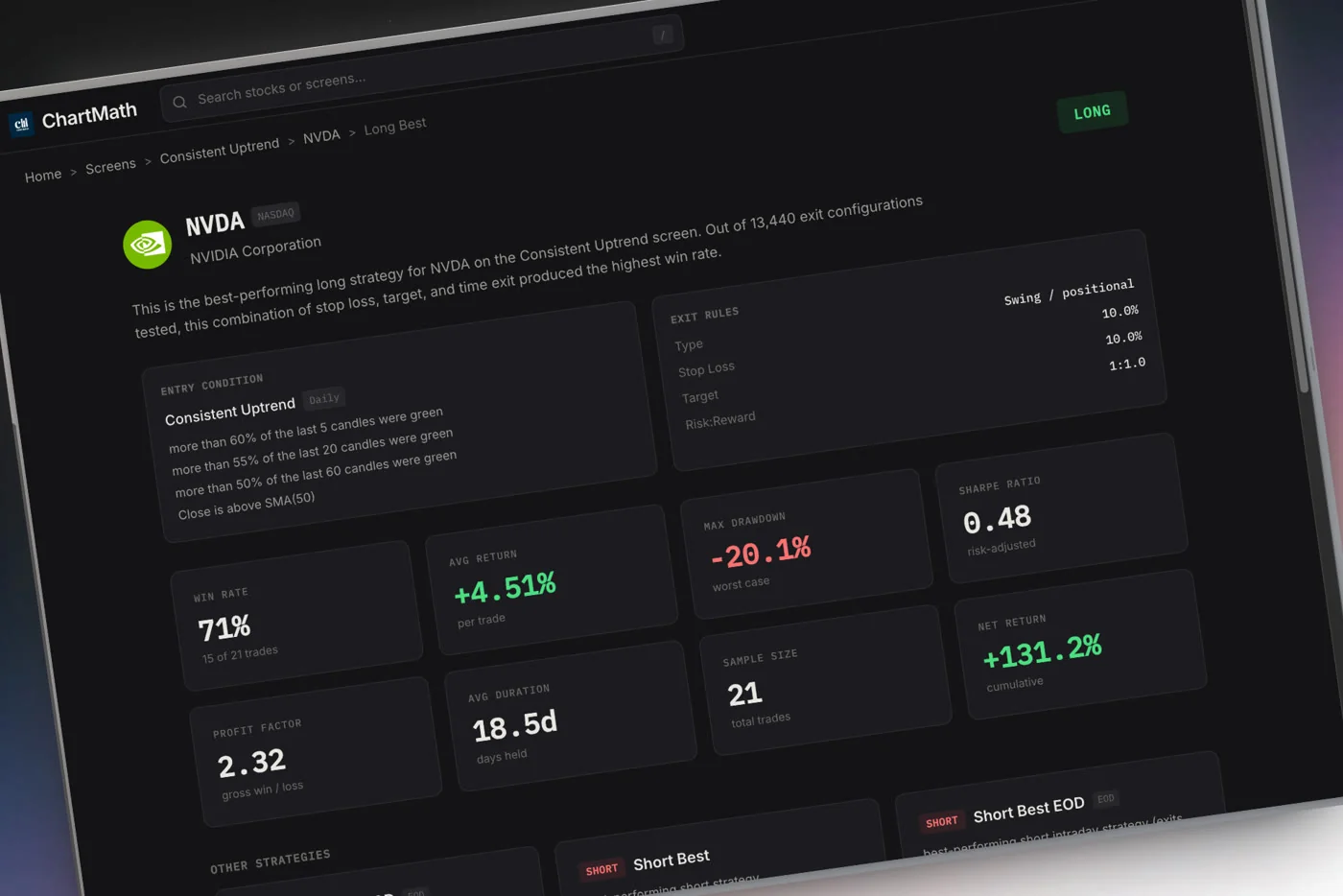
More importantly, a backtested screen carries a historical track record. Every screen has been run against historical price data to measure how often setups that matched those rules went on to produce a profitable outcome. That produces a Win Rate and an Average Return across the full sample. Not a self-reported number. Not a cherry-picked highlight reel. A statistical record of how the pattern performed.
That's a fundamentally different kind of information than a signal group provides. When you see a setup from a backtested screen, you know the rules that triggered it, and you know the historical baseline for how similar setups have performed. That's the foundation of a systematic approach.
One important caveat: backtests are historical, not predictive. They use bar-close entries with no look-ahead bias, but they don't model commissions, slippage, or spread. A historical Win Rate is evidence of a pattern's past behavior, not a guarantee of future results. The value isn't certainty. It's an auditable starting point for your own decision-making.
For traders who want to understand how to read and apply backtest data properly, the post on building winning backtesting strategies goes deeper on the methodology.
Head-to-Head: Signal Group vs Backtested Screener
Here's how the two approaches compare across the dimensions that actually matter for building a systematic trading process.
| Dimension | Discord Signal Group | Backtested Screener |
|---|---|---|
| Track record | Self-reported or absent | Historical Win Rate + Avg. Return per screen |
| Rule transparency | Hidden or informal | Visible filter rules for every screen |
| Promotion risk | Possible; no structural protection | None; algorithmic, rule-based |
| Timing reliability | Variable; depends on when you see the post | Alert fires the moment a ticker enters a screen |
| Risk framework | Rarely defined | Screen defines the setup; trader sets position size and exit |
| Systematic repeatability | No | Yes |
| Requires coding | No | No (with ChartMath) |
The screener doesn't make the decision for you. It surfaces setups with auditable history. You evaluate the setup, check your own chart, decide whether it fits your plan, and execute in your own brokerage. That's the right division of labor between a tool and a trader. If you want to see the difference in practice, unlike a signal group, every setup we post on our @BacktestedSetups channel is tied to a screen with a historical, backtested track record you can audit.
Why "Copilot, Not Autopilot" Matters Here
There's a version of this comparison that goes wrong in the other direction: traders who assume a backtested screener will just tell them what to do. It won't. A screener is a research tool, not a trading bot. It has no broker connection. It doesn't place orders. It doesn't manage positions.
That's actually the point. When you follow a Discord signal, you're outsourcing the decision entirely to someone you can't audit. When you use a backtested screener, you're getting structured, verifiable information, and then making your own call. You stay in control of position size, entry timing, and exit. The screener is a copilot, not an autopilot.
This matters especially for traders with a day job. You're not going to be watching charts at 10:43 AM. What you need is a tool that does the scanning for you, fires an alert when something qualifies, and gives you enough information to evaluate the setup on your own time. That's a very different workflow from refreshing a Discord server hoping you didn't miss the call. The post on swing trading with a full-time job covers how to build that workflow in practice.
How ChartMath Fits Into This Framework
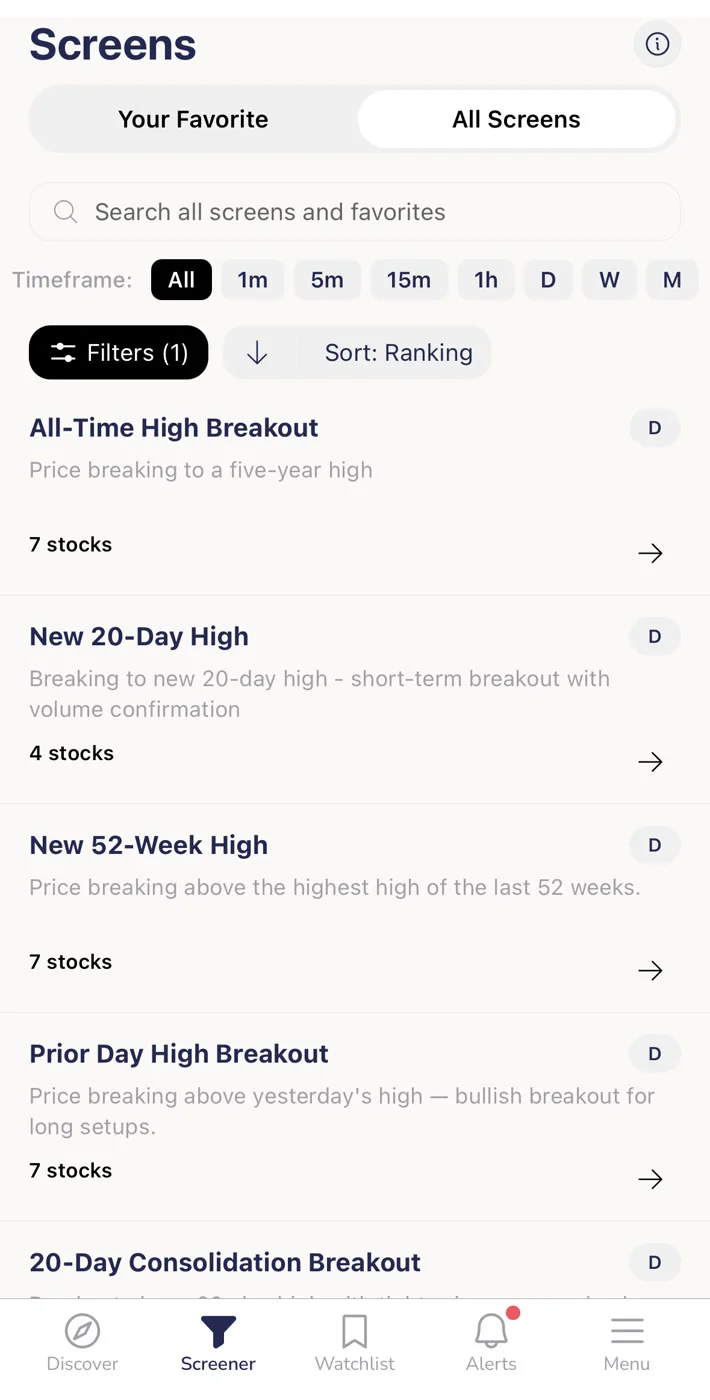
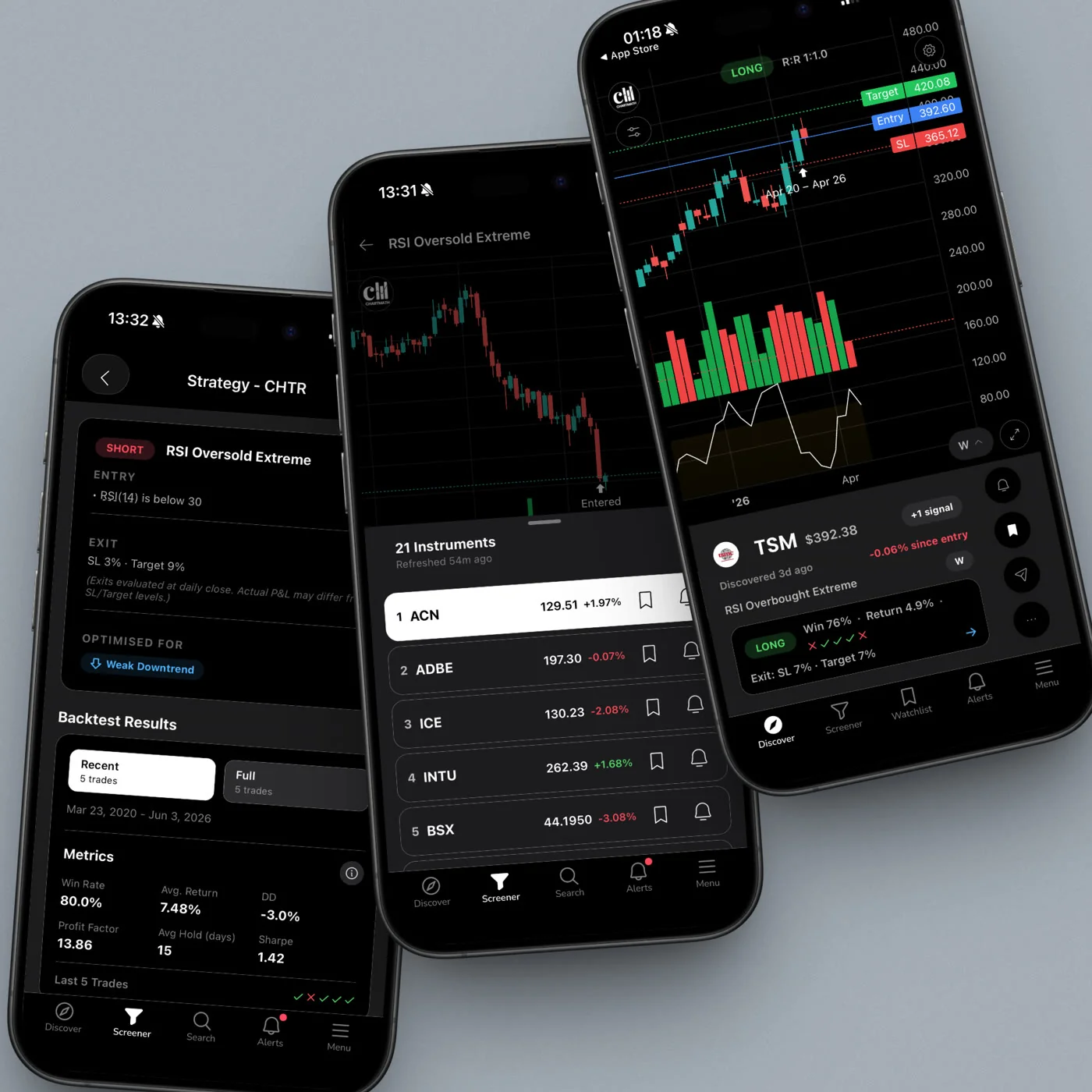
ChartMath is a mobile-first trade-discovery app built specifically for swing traders who can't watch charts all day. It scans 500+ US equities, 100 crypto pairs, and 11 US futures across 200+ curated, read-only backtested screens and 7 timeframes (1m, 5m, 15m, 1h, Daily, Weekly, Monthly).
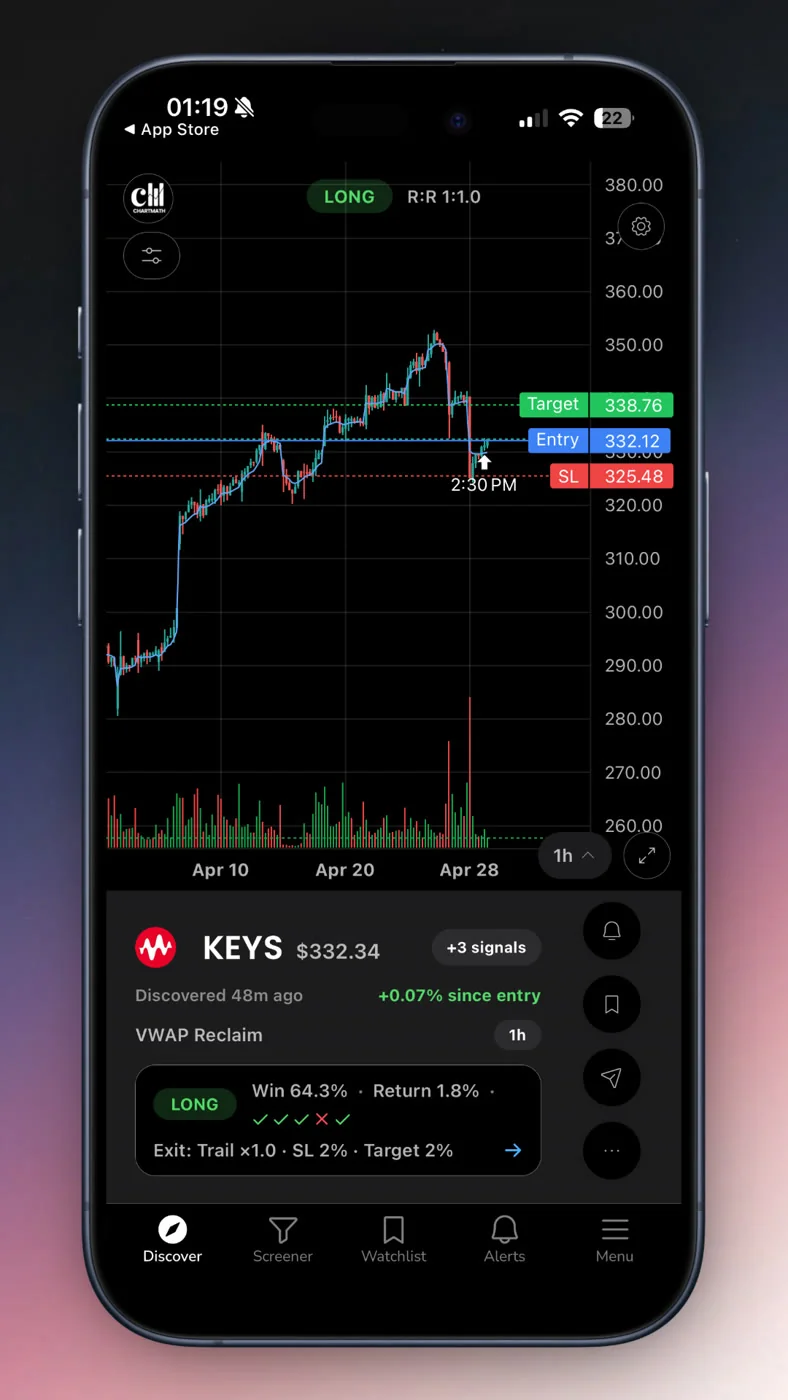
Every screen in ChartMath is pre-built and backtested before it ships. There's no Pine Script, no coding, no screen builder. You browse the screen library, read the filter rules in plain English, check the historical Win Rate and Average Return, and favorite the screens that match your strategy. When a ticker enters one of your favorited screens, you get a push alert and an in-app notification with the screen name, the timeframe, and a deep link back to the setup.
The screen's filter rules are visible. The historical track record is attached to the screen, not to a specific ticker. Every stock that enters a given screen is evaluated against the same rule set and the same historical baseline. There's no cherry-picking. There's no self-reported win rate. The data is the same for every user looking at the same screen.
ChartMath is a copilot. It surfaces setups. You verify on your own chart, decide whether the setup fits your plan, and execute in your own brokerage. No broker connection, no auto-trading, no orders placed on your behalf.
ChartMath is free.
For traders who want to see the screen library before downloading the app, the web-based screener at chartmath.com/screens lets you browse all 200+ screens anonymously, no sign-in required.
Making the Switch: A Practical Starting Point
Switching from a signal group to a backtested screener isn't complicated, but it does require a shift in how you think about trade discovery. Here's a five-step starting point.
- Pick two or three screens whose rules you understand. Browse the screen library and read the filter criteria. If you can explain in plain English why a stock would enter that screen, you understand it well enough to trade it. Start narrow. Two or three screens you understand deeply are worth more than twenty you're following blindly.
- Review the Win Rate and Average Return. These are historical figures, not forecasts. Look at the sample size too. A screen with a high Win Rate across a small sample is less reliable than one with a moderate Win Rate across a large sample. Understand what the historical edge actually looks like before you commit to a screen.
- Favorite those screens to activate alerts. Once you've chosen your screens, favorite them in the app. From that point, you'll get a push alert and in-app notification whenever a ticker in the universe enters one of those screens. You don't need to be watching charts.
- Verify on your own chart before acting. An alert is a starting point, not a trade instruction. When one fires, pull up the chart in your own platform, confirm the setup looks right to you, and check whether the risk/reward fits your plan. The screener did the scanning. You make the call. For traders building this into a daily routine, the post on building an efficient trading workflow covers the full process.
- Track your own results against the screen's historical baseline. Over time, compare your actual outcomes to the screen's historical Win Rate and Average Return. That comparison tells you whether you're executing the setup correctly and whether the screen continues to perform in current market conditions. This is how you build a real, personal track record, not a borrowed one.
For traders who want to understand how to stop watching charts all day while still catching setups, the post on trading stocks without watching the screen all day covers the alert-driven workflow in detail.
Frequently Asked Questions
Are Discord trading signals illegal?
Not inherently. Sharing trade ideas in a community is legal. The legal risk arises when someone provides personalized investment advice without being a registered investment adviser, or when signals are used to manipulate prices (pump-and-dump). The SEC has issued specific guidance on this. Even when a group operates legally, the structural problems around verifiability and track records remain.
Can a backtested screener guarantee profits?
No. Historical Win Rate and Average Return are records of past performance, not forecasts. Backtests use bar-close entries with no look-ahead bias, but they don't model commissions, slippage, or spread. Past performance does not guarantee future results. The value of a backtested screen is an auditable starting point for your own decision-making, not a promise of outcomes.
Do I need coding skills to use a backtested screener?
Not with ChartMath. All 200+ screens are pre-built and ready to use. No Pine Script, no coding, no screen builder. You browse, read the rules, and favorite the screens that fit your strategy. The post on using a stock scanner without Pine Script covers this in more detail.
What markets does ChartMath cover?
ChartMath is US-first: 500+ US equities (NYSE/Nasdaq), 100 crypto pairs, and 11 US futures, across 7 timeframes from 1-minute to monthly.
Is ChartMath free?
Yes. ChartMath is free. No credit card required.
How is ChartMath different from TradingView or Finviz?
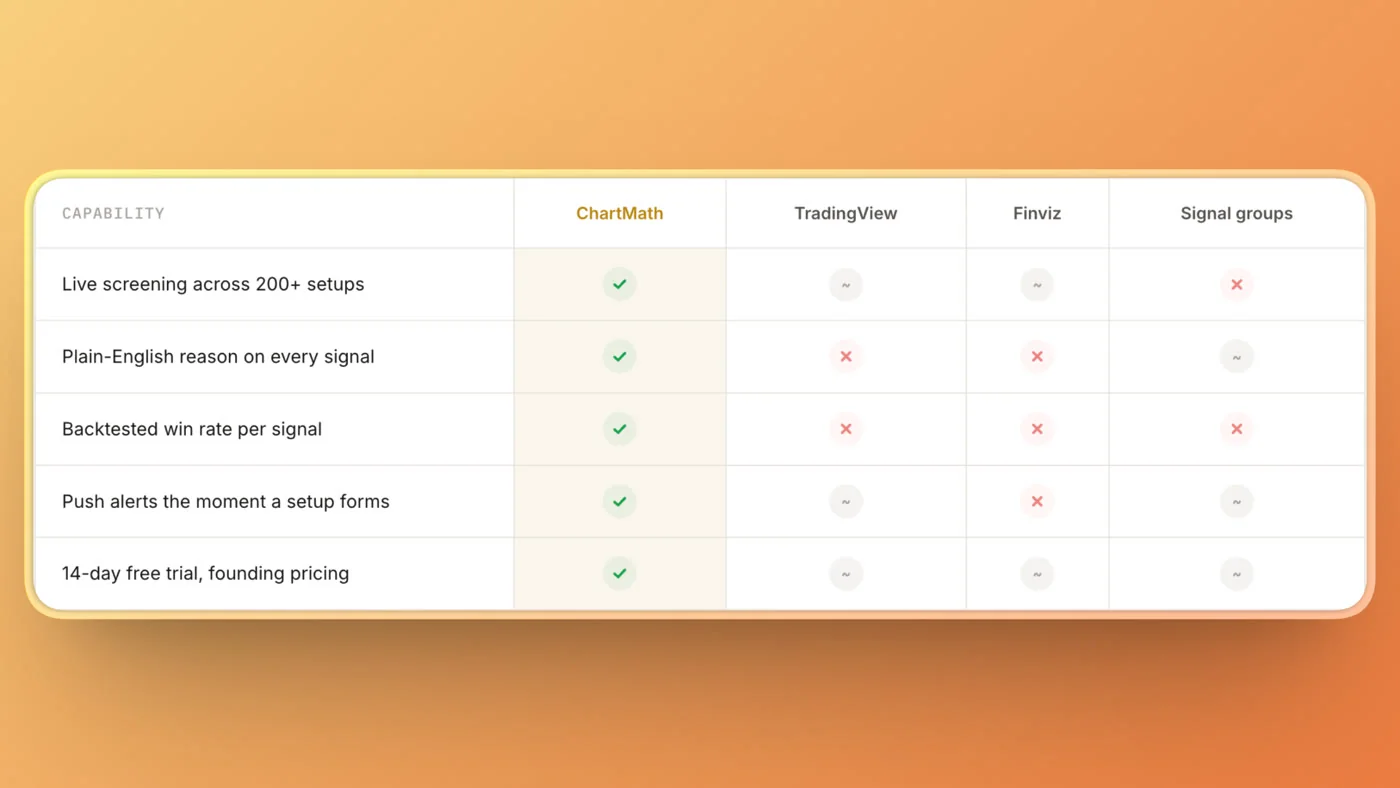
TradingView and Finviz are powerful tools for charting and static screening, but neither provides a backtested Win Rate and Average Return attached to each screen, and neither sends push alerts to your phone the moment a setup forms. ChartMath is designed to work alongside your existing charting platform, not replace it. It handles the scanning and alerting; you handle the analysis and execution.
The Bottom Line
Discord trading signals can be entertaining. They can occasionally surface ideas worth investigating. What they can't do is make you systematic. There's no auditable track record, no rule transparency, no risk framework, and no way to know whether you're following a real edge or someone else's guess.
A backtested screener gives you something structurally different: defined rules, historical Win Rate and Average Return, and alerts that fire the moment a ticker qualifies. You still make every decision. You still execute in your own brokerage. But you're working from verifiable information instead of borrowed conviction.
If you're ready to trade from data instead of tips, browse the full screen library at chartmath.com/screens, or get the app at chartmath.com/app. Start for free.

See these setups live in ChartMath
200+ curated screens with backtest data. Free. No credit card required.