Swing Trading With a Full-Time Job: 20-Min Daily Routine
It's 3 PM. You're in your fourth meeting of the day, phone face down on the table because that's what a professional does. Somewhere behind that dark screen, a stock you flagged on Monday might have just crossed above its 50-day moving average. You have no idea. You won't know until the meeting ends at 3:40, and by then the first leg of the move is usually gone. Swing trading with a full time job in India feels impossible in that exact moment, but the problem isn't the job or the 9:15-15:30 IST session. The problem is trying to trade like a day trader when you only have twenty minutes to spare.
Key Takeaways
- Swing trading fits a full-time job: holds run for days, so you don't need to watch a live chart during work hours, only check it twice a day.
- The routine is three blocks: a 5-7 minute pre-market pass before 9:15 AM IST, alert-only monitoring through the session, and a 20-minute weekend review.
- Alerts do the watching: a push notification only fires when a setup you already vetted actually triggers, so meetings stop costing you entries.
- Grade decisions, not outcomes: your weekend review should ask "did I follow the plan," not "did I make money on this one trade."
- This is educational, not advice: nothing here is a stock recommendation, and no tool here is a SEBI-registered adviser.
At a Glance: The 20-Minute Routine
| Routine Block | Time Window (IST) | What You Actually Do | Time Cost |
|---|---|---|---|
| Pre-market pass | Before 9:15 AM | Check overnight setups on your shortlist, set alerts, close the app | 5-7 minutes |
| In-session monitoring | 9:15 AM - 3:30 PM | Phone face down, alerts only, no chart refreshing | ~0 active minutes |
| Alert review | Whenever a push fires | Glance, confirm the setup still matches your plan, act or dismiss | 1-2 minutes per alert |
| Weekend review | Saturday or Sunday | Log 3-5 trades, grade the decision against the rule, not the P&L | 15-20 minutes |
| Position count | Ongoing | Keep 3-6 open swing positions, not 20 | N/A |
| Instruments in scope | N/A | NSE cash equities only, no F&O, no MCX, no indices | N/A |
Why the 9:15-15:30 Session Isn't a Disqualifier
Most working professionals assume the Indian market being open exactly when they're at their desk rules them out. That assumption only holds if you're trying to scalp five-minute candles between calls. Swing trading doesn't ask for that. A position you hold for three to ten days doesn't care whether you watched the 11:47 AM tick. It cares whether you had a rule before you entered and whether you follow it when the rule fires.
The shift that matters is smaller than most guides make it sound: stop treating the chart as something you check, and start treating it as something that checks you. A pre-built, backtested screen already ran the scan. Your job is to review the shortlist once before the bell, and then let an alert tell you when something on that list actually moves.

This is the same argument covered in more depth in Swing Trading with a Full-Time Job: A Real System, but the India-specific version has one added wrinkle: your session hours are fixed by SEBI trading rules, 9:15 AM to 3:30 PM, and you cannot change that. What you can change is how much of it you spend staring at a screen.
1. The Pre-Market Pass (Before 9:15 AM IST)
Do this before you leave for work, or before your first call. It takes five to seven minutes, not thirty.
- Open your shortlist, not the whole market. You should already have a small watchlist, six to ten names, not a hundred. Scanning a hundred tickers before 9:15 is how the habit dies in a week.
- Check which names are near a trigger. A rule-based screen like a consistent uptrend pattern, a golden cross setup, or a low-volatility compression pattern either matched overnight or it didn't. You're reading a yes/no, not staring at candles trying to guess.
- Set the alert and close the app. If a name is close to triggering, arm an alert for it. If nothing is close, you're done. Walk away.

Screens worth building this shortlist from include a consistent uptrend daily pattern, a golden cross daily crossover, and a low-volatility compression setup, the kind of base that often precedes a breakout. Each of these is a fixed, stated rule, which means its historical record can be recomputed rather than taken on faith. That distinction matters more than the setup itself: a rule you can't recheck isn't really a rule.
2. In-Session: Alerts, Not Screens (9:15 AM - 3:30 PM IST)
This is the block where most working traders leak money, not through bad trades but through bad attention. You check the chart between calls, see nothing has happened, get bored, check again twenty minutes later, and eventually either miss the real move or jump into a name too early out of restlessness.
The fix is structural, not willpower-based: put the phone face down and let a push alert do the watching. A well-built alert only fires when a ticker you already vetted enters a screen you already trust, not on every tick and not on every ticker in the market. That's the difference between an alert stream and noise you learn to ignore, which is a problem covered at length in How to Avoid Alert Fatigue From Stock Screeners.
One thing worth being direct about: this is a copilot, not an autopilot. Nothing here places a trade for you automatically. An alert tells you a setup triggered; you still decide, and you still tap to act. That's a deliberate boundary, not a missing feature. The goal is fewer decisions during the workday, not zero decisions.
If you're building a broader shortlist beyond three names, the routine scales the same way described in How to Integrate a Stock Screener Into Your Daily Routine: premarket, in-session alerts, end of day. The India timing just shifts to 9:15-15:30 IST instead of the US session.
3. The Weekend Review (20 Minutes, Saturday or Sunday)
Most traders review outcomes. Did the trade make money, yes or no. That's the wrong question, because a good process can lose money on any single trade and a bad process can win by accident. The question that actually improves you over a month is: did I follow the rule?

- Pull up your 3-5 trades from the week. Not more. If you took fifteen trades in a week on a swing timeframe, something is off, either your position sizing or your patience.
- For each one, ask: did I enter on the rule, or on a feeling? If the screen said enter and you entered, that's a good decision, regardless of the outcome.
- Check if the stop was honored. Moving a stop mid-trade because it "feels close" is the single most common leak in a swing account.
- Look for a pattern over 3-4 weeks, not one week. A single bad week tells you almost nothing. A month of the same mistake tells you exactly where to fix your process.
For a structured version of this, How to Run a Weekly Trading Review in 20 Minutes walks through a template you can reuse every Sunday.
What to Cut From Your Current Routine
Part of building a routine is deciding what to stop doing. Here's the short list:
- Refreshing a scanner tab between meetings. If you're manually checking Chartink or a similar tool six times a day, that's screen time an alert should be doing for you.
- Following calls from Telegram or WhatsApp trading groups. A tip with no documented track record and no stated rule isn't a strategy, it's a guess with someone else's confidence attached.
- Trying to nail the exact intraday entry on a swing thesis. If your holding period is three to ten days, the difference between entering at 10:02 AM and 10:47 AM rarely matters to the outcome.
- Checking price twenty times a day. This one is less about performance and more about your own sanity through the workday.
Where Other Screening Tools Fit In
To be fair to what's already out there: Indian traders aren't starting from zero on backtesting. Trendlyne offers backtestable screeners with a winners-to-losers ratio, TradingView ships strategy testing through Pine Script for traders willing to code, and Streak layers backtested rule strategies on top of broker connections for NSE stocks. None of these are hollow tools, and if you're already comfortable in one, the routine in this article works with it just as well as with anything else.
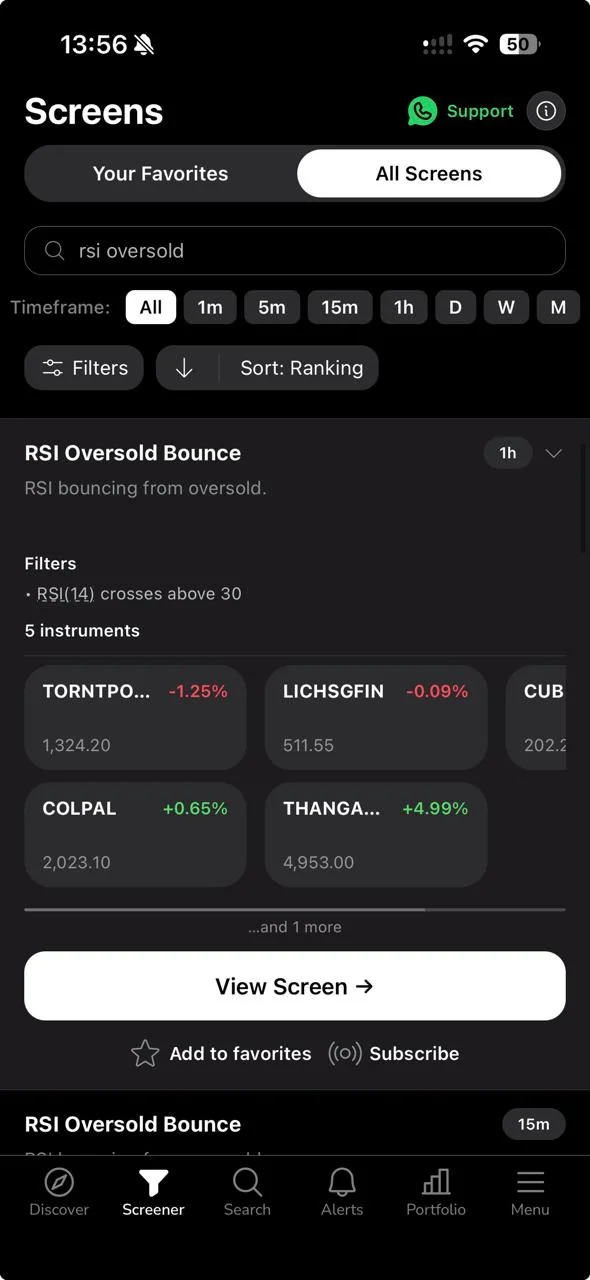
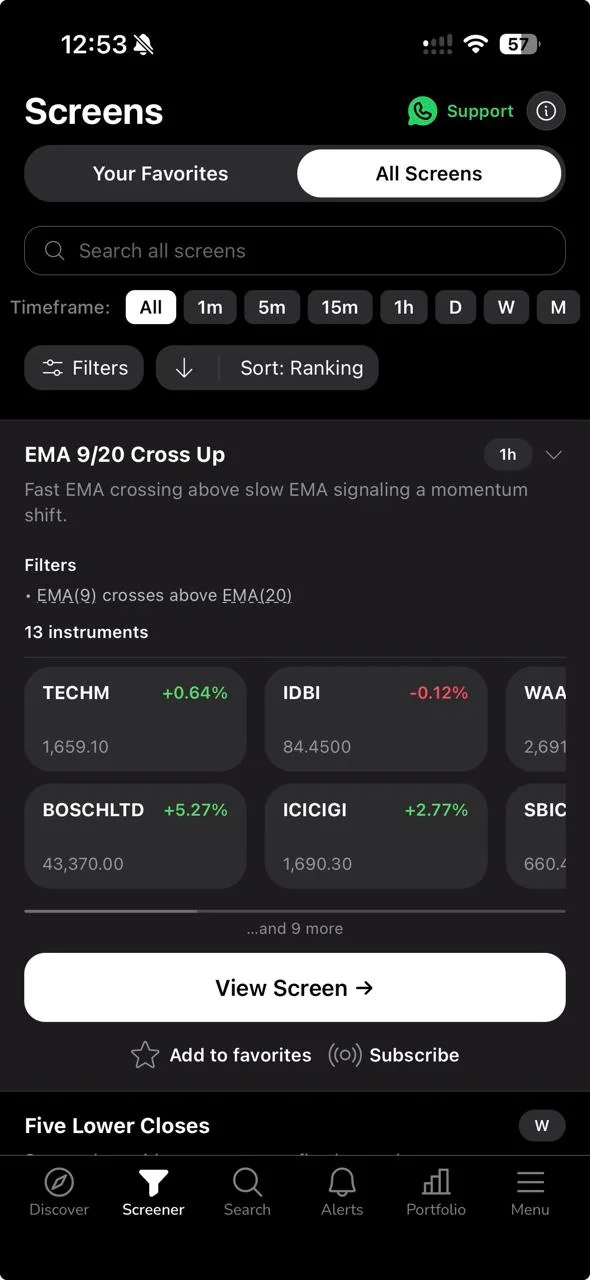
What ChartMath adds to that routine specifically is 200+ pre-built, no-code screens, each carrying a plain-English reason and a backtested Win Rate and Avg. Return, delivered as a push alert instead of something you have to go check. You don't write Pine Script, you don't build a screener from scratch, you pick a rule from the shortlist above and let it ping you. It's free with no credit card required, on both iOS and Android.
You can browse the full catalog of screen pages and read each rule and its record before committing to anything on mobile. Those pages run the US universe; for NSE names, switch the market to India inside the app.
Frequently Asked Questions
Can I really swing trade with a 9-to-6 job in India?
Yes, as long as your holding period is measured in days, not minutes. The 9:15-15:30 IST session only conflicts with your job if you're trying to trade intraday moves you can't watch.
How many stocks should I track at once?
Six to ten on your shortlist, with three to six open positions at a time. A larger watchlist doesn't add edge, it adds noise you'll ignore within a week.
What if I miss the pre-market pass one day?
Nothing breaks. Your alerts are still armed from the prior pass. You'll catch up at the weekend review, which is the checkpoint that actually matters for improvement.
Is any of this trading advice or a stock recommendation?
No. This article is educational content on building a routine, not a recommendation to buy or sell any named stock. ChartMath is not a broker/dealer or investment adviser and is not registered with SEBI. Educational use only. Not a broker/dealer or investment adviser and not registered with SEBI. Past performance does not indicate future results.
The routine that survives a busy job isn't the one with the most alerts. It's the one where silence is the default state, and your phone only speaks up when something you already agreed to matters.
If checking charts between meetings has cost you entries more times than you'd like to admit, the fix isn't more discipline, it's a smaller routine that doesn't need it. Start your pre-market pass tomorrow before 9:15 AM, arm alerts on two or three names from a screen like a backtested NSE swing screener, and let the rest of the day happen without you watching. Download the app and put the phone down. That's the whole system.

See these setups live in ChartMath
200+ curated screens with backtest data. Free. No credit card required.